MCQ
Consider a solid sphere of radius $\mathrm{R}$ and mass density $\rho(\mathrm{r})=\rho_{0}\left(1-\frac{\mathrm{r}^{2}}{\mathrm{R}^{2}}\right),  0<\mathrm{r} \leq \mathrm{R} .$ The minimum density of a liquid in which it will float is
  • A
    $\frac{\rho_{0}}{5}$
  • B
    $\frac{\rho_{0}}{3}$
  • C
    $\frac{2\rho_{0}}{3}$
  • $\frac{2\rho_{0}}{5}$

Answer

Correct option: D.
$\frac{2\rho_{0}}{5}$
d
In case of minimum density of liqued, sphere will be floating while completely submerged So $\mathrm{mg}=\mathrm{B}$

$\mathrm{m}=\int_{0}^{\mathrm{R}} \rho\left(4 \pi \mathrm{r}^{2} \mathrm{dr}\right)=\mathrm{B}$

$=\rho_{0} \int_{0}^{R}\left(1-\frac{r^{2}}{R^{2}}\right) 4 \pi r^{2} d r=\frac{4}{3} \pi R^{3} \rho_{\ell} g$

On Solving

$\rho_{\ell}=\frac{2 \rho_{0}}{5}$

Need a full question paper?

Generate a complete, print-ready paper with questions like this in minutes — across 16+ boards, with answer keys.

Start Generating Free

Similar questions

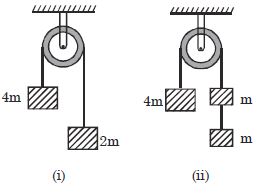
In the arrangement shown in figure, pulley is smooth and massles and all the strings are  light let $F_1$ be the force exerted on the pulley in case $(i)$ and $F_2$ the force in case $(ii)$. Then
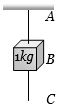
A mass of $1 kg$ is suspended by a string $A$. Another string $C$ is connected to its lower end (see figure). If a sudden jerk is given to $C$, then
Which of the following four statements is false
A soap bubble in a form of circular tube having radius of curvature $R$ and radius of curvature perpendicular to it is $5R$ . Find the excess pressure in the bubble :
Diatomic molecules like hydrogen have energies due to both translational as well as rotational motion. From the equation in kinetic theory $\text{PV} = \frac{2}{3}$ E,E is:
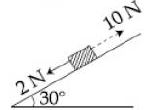
A block kept on a rough inclined plane, as shown in the figure, remains at rest upto a maximum force $2\,N$ down the inclined plane. The maximum external force up the inclined plane that does not move the block is $10\,N.$ The coefficient of static friction between the block and the plane is : [Take $g = 10\,m/s^2$ ]
A spherical body of radius $R$ consists of a fluid of constant density and is in equilibrium under its own gravity. If $P ( r )$ is the pressure at $r ( r < R )$, then the correct option$(s)$ is(are)

$(A)$ $P ( I =0)=0$ $(B)$ $\frac{ P ( r =3 R / 4)}{ P ( r =2 R / 3)}=\frac{63}{80}$

$(C)$ $\frac{ P ( r =3 R / 5)}{ P ( r =2 R / 5)}=\frac{16}{21}$ $(D)$ $\frac{ P ( r = R / 2)}{ P ( r = R / 3)}=\frac{20}{27}$

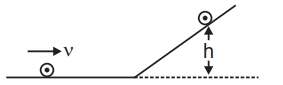
A disc of radius $R$ and mass $M$ is rolling horizontally without slipping with speed $v$. It then moves up an inclined smooth surface as shown in figure. The maximum height that the disc can go up the incline is:
In how many directions (at angles) can a body be projected with the same speed for the same range?
Two resistors $A$ and $B$ have resistances $R_A$ and $R_B$, respectively, and $R_A$