MCQ
Consider a sphere of mass $‘m’$ radius $‘R’$ doing pure rolling motion on a rough surface having velocity $\rho$ as shown in the Fig. It makes an elastic impact with the smooth wall and moves back and starts pure rolling after some time again.
  • A
    Change in angular momentum about $‘O’$ in the entire motion equals $2mv_0R$ in magnitude.
  • B
    Moment of impulse provided by the wall during impact about $O$ equals $2mv_0R$ in magnitude.
  • C
    Final velocity of ball will be $ - \frac{3}{7}{\vec v_0}$
  • All of the above

Answer

Correct option: D.
All of the above
d

Need a full question paper?

Generate a complete, print-ready paper with questions like this in minutes — across 16+ boards, with answer keys.

Start Generating Free

Similar questions

In intrinsic semiconductor at room temperature, number of electrons and holes are
Two blocks $A$ and $B$ of masses $5 \,kg$ and $3 \,kg$ respectively rest on a smooth horizontal surface with $B$ over $A$. The coefficient of friction between $A$ and $B$ is $0.5$. The maximum horizontal force (in $kg$ wt.) that can be applied to $A$, so that there will be motion of $A$ and $B$ without relative slipping, is
A kettle with $2\, littre$ water at $27\,^oC$ is heated by operating coil heater of power $1\, kW$. The heat is lost to the atmosphere at constant rate $160\, J/sec$, when its lid is open. In how much time will water heated to $77\,^oC$. (specific heat of water $= 4.2\, kJ/kg$) with the lid open ?
A soap bubble of radius $R$ is blown. After heating the solution a second bubble of radius $2R$ is blown. The work required to blow the second bubble in comparison to that required for the first bubble is
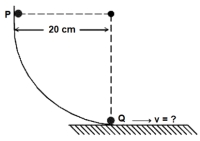
As per the given figure, a small ball $P$ slides down the quadrant of a circle and hits the other ball $Q$ of equal mass which is initially at rest. Neglecting the effect of friction and assume the collision to be elastic, the velocity of ball $Q$ after collision will be $............\,m/s$ $:\left( g =10\,m / s ^2\right)$
Given below are two statements : one is labelled as Assertion (A) and the other is labelled as Reason (R).
Assertion (A) : The outer body of an air craft is made of metal which protects persons sitting inside from lightning-strikes.
Reason (R): The electric field inside the cavity enclosed by a conductor is zero.
In the light of the above statements, chose the most appropriate answer from the options given below :
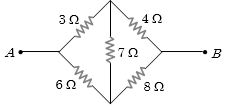
Calculate the net resistance of the circuit between $A$ and $B$
The maximum horizontal range of a projectile is $400\;m$.The maximum height atteined by it?
To a person, going eastward in a car with a velocity of $25\, km/hr$, a train appears to move towards north with a velocity of $25\sqrt 3 $ $km/hr$. The actual velocity of the train will be..........$km/hr$
In a $RA$ element the fraction of initiated amount remaining after its mean life time is