Question
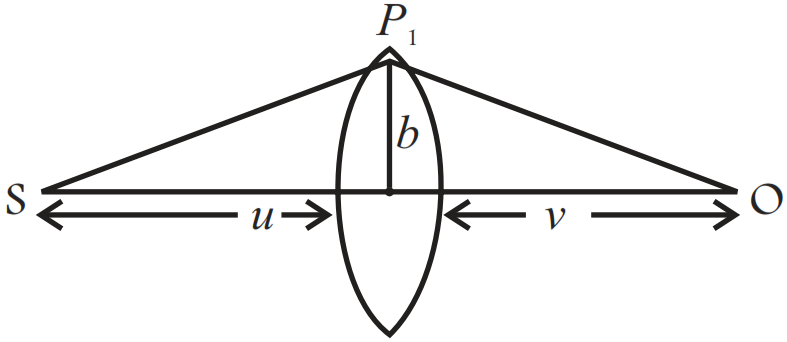
Consider a thin lens placed between a source (S) and an observer (O) (Fig). Let the thickness of the lens vary as $\text{w}\text{(b)}=\text{w}_0-\frac{\text{b}^2}{\alpha}$, where b is the verticle distance from the pole. w0 is a constant. Using Fermat’s principle i.e. the time of transit for a ray between the source and observer is an extremum, find the condition that all paraxial rays starting from the source will converge at a point O on the axis. Find the focal length.
Answer

The time taken by ray to travel from S to P1 is
$\text{t}_1=\frac{\text{SP}_1}{\text{c}}=\frac{\sqrt{\text{u}^2+\text{b}^2}}{\text{c}}$
or $\text{t}_1=\frac{\text{u}}{\text{c}}\Big(1+\frac{1}{2}\frac{\text{b}^2}{\text{u}^2}\Big)$ assuming b < < 1.
The time required to travel from P1 to O is
$\text{t}_2=\frac{\text{P}_1\text{O}}{\text{c}}=\frac{\sqrt{\text{v}^2+\text{b}^2}}{\text{c}}=\frac{\text{v}}{\text{c}}\Big(1+\frac{1}{2}\frac{\text{b}^2}{\text{v}^2}\Big)$
The time required to travel through the lens is
$\text{t}=\frac{(\text{n}-1)\text{w}(\text{b})}{\text{c}}$
where n is the refractive index.
Thus, the total time is
$\text{t}=\frac{1}{\text{c}}\bigg[\text{u}+\text{v}+\frac{1}{2}\text{b}^2\Big(\frac{1}{\text{u}}+\frac{1}{\text{v}}\Big)+(\text{n}-1)\text{w}(\text{b})\bigg]$
Put $\frac{1}{\text{D}}=\frac{1}{\text{u}}+\frac{1}{\text{v}}$
Then, $\text{t}=\frac{1}{\text{c}}\bigg[\text{u}+\text{v}+\frac{1}{2}\frac{\text{b}^2}{\text{D}}+(\text{n}-1)\Big(\text{w}_0+\frac{\text{b}^2}{\alpha}\Big)\bigg]$
Fermat's principle gives the time taken should be minimum.
For that first dericative should be zero.
$\frac{\text{dt}}{\text{db}}=0=\frac{\text{b}}{\text{CD}}-\frac{2(\text{n}-1)\text{b}}{\text{c}\alpha}$
Thus, a convergent lens is formed if $\alpha=2(\text{n}-1)\text{D}$. This is independent of and hence all paraxial rays from S will converge at O i.e., for rays b < < n and b < < v.
Since, $\frac{1}{\text{D}}=\frac{1}{\text{u}}+\frac{1}{\text{v}}$, the focal length is D.

Need a full question paper?

Generate a complete, print-ready paper with questions like this in minutes — across 16+ boards, with answer keys.

Start Generating Free

Similar questions

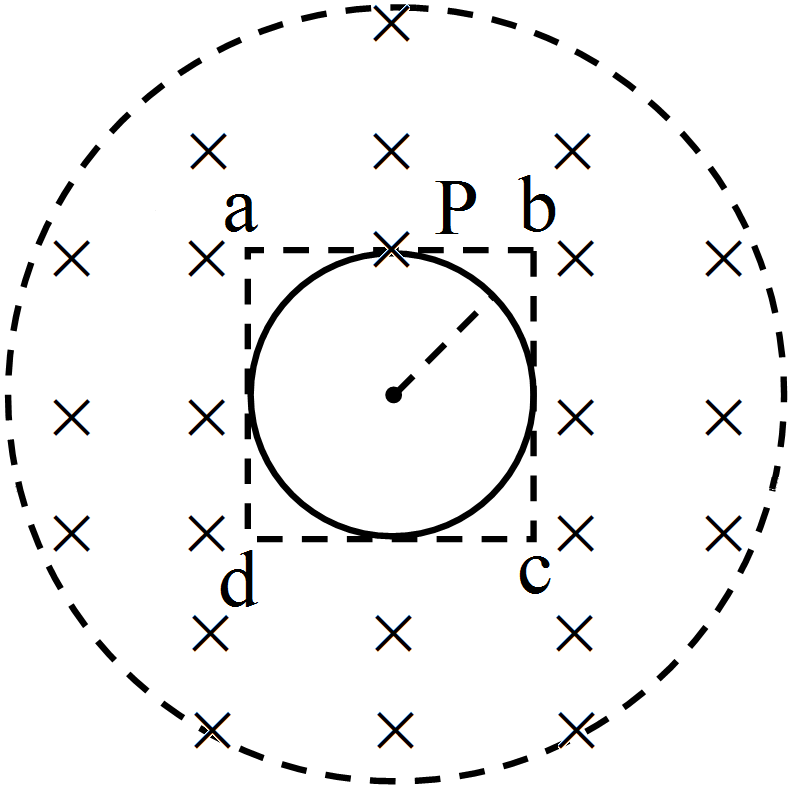
A uniform magnetic field B exists in a cylindrical region, shown dotted in figure. The magnetic field increases at a constant rate $\frac{\text{dB}}{\text{dt}}.$ Consider a circle of radius r coaxial with the cylindrical region.

  1. Find the magnitude of the electric field E at a point on the circumference of the circle.
  2. Consider a point P on the side of the square circumscribing the circle. Show that the component of the induced electric field at P along ba is the same as the magnitude found in part (a).


Consider a non-conducting plate of radius r and mass m that has a charge q distributed uniformly over it. The plate is rotated about its axis with an angular speed $\omega.$ Show that the magnetic moment $\mu$ and the angular momentum of the plate are related as $\mu=\frac{\text{q}}{2\text{m}}\text{l}.$
Assume that a tunnel is dug across the earth (radius = R) passing through its centre. Find the time a particle takes to cover the length of the tunnel if,
  1. It is projected into the tunnel with a speed of $\sqrt{\text{gR}}.$
  2. It is released from a height R above the tunnel.
  3. It is thrown vertically upward along the length of tunnel with a speed of $\sqrt{\text{gR}}.$
A hollow sphere of radius 2cm is attached to an 18cm long thread to make a pendulum. Find the time period of oscillation of this pendulum. How does it differ from the time period calculated using the formula for a simple pendulum?
  1. Using Biot-Savart’s law, derive the expression for the magnetic field in the vector form at a point on the axis of a circular current loop.
  2. What does a toroid consist of ? Find out the expression for the magnetic field inside a toroid for N turns of the coil having the average radius r and carrying a current I. Show that the magnetic field in the open space inside and exterior to the toroid is zero.
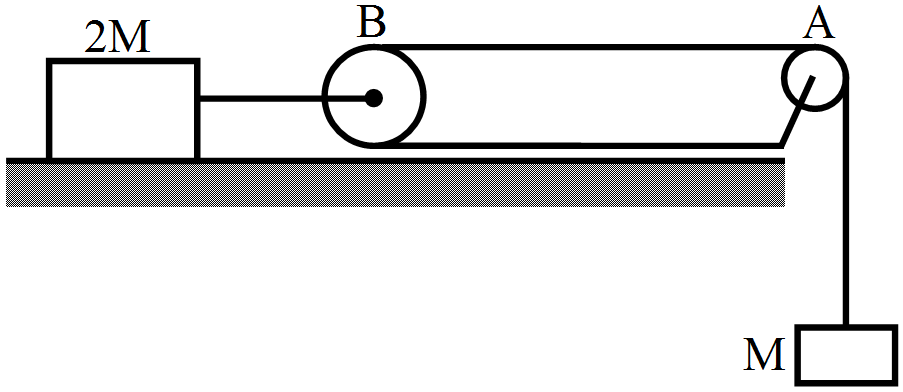
Consider the situation shown in figure. Both the pulleys and the string are light and all the surfaces are frictionless.
  1. Find the acceleration of the mass M.
  2. Find the tension in the string.
  3. Calculate the force exerted by the clamp on the pulley A in the figure.
​​​​​​​
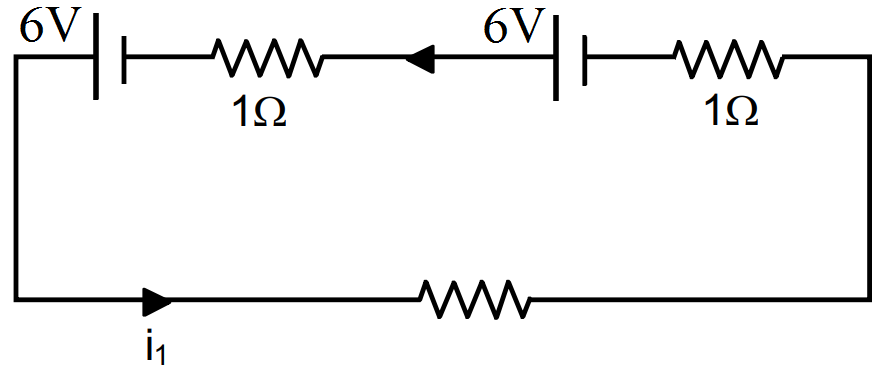
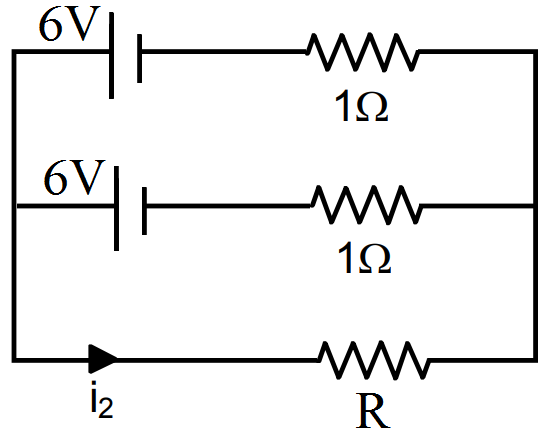
Find the value of $\frac{\text{i}_1}{\text{i}_2}$ in the figure. if (a) $\text{R}=0.1\Omega$ (b) $\text{R}=1\Omega$ and (c) $\text{R}=10\Omega.$ Note from your answers that in order to get more current from a combination of two batteries, they should be joined in parallel if the external resistance is small and in series if the external resistance is large, compared to the internal resistance.

The initial pressure and volume of a given mass of a gas $\Big(\frac{\text{C}_\text{P}}{\text{C}_\text{V}}=\gamma\Big)$ are P0 and V0. The gas can exchange heat with the surrounding.
  1. It is slowly compressed to a volume $\frac{\text{V}_0}{2}$ and then suddenly compressed to $\frac{\text{V}_0}{4}.$ Find the final pressure.
  2. If the gas is suddenly compressed from the volume V0 to $\frac{\text{V}_0}{2}$ and then slowly compressed to $\frac{\text{V}_0}{4},$ what will be the final pressure?
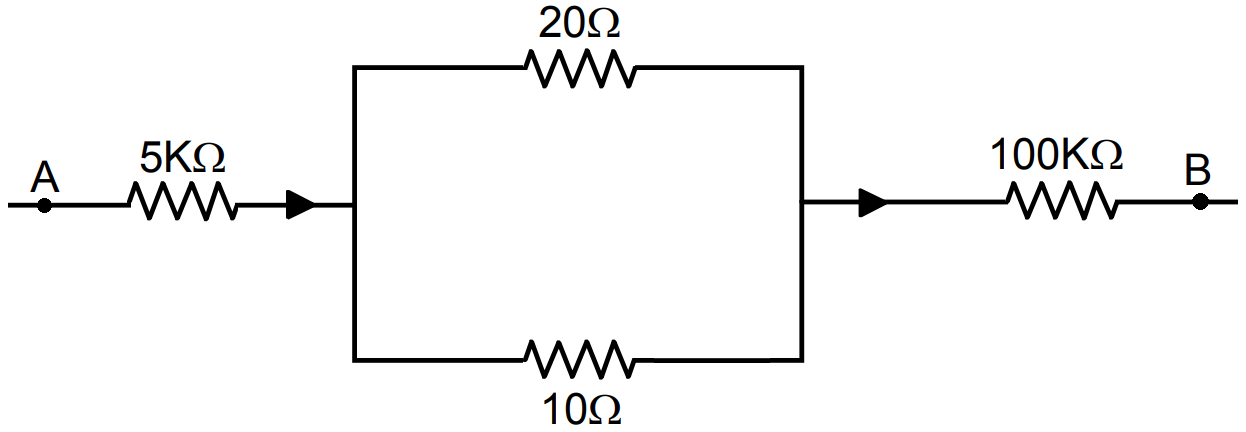
Figure. shows a part of a circuit. If a current of 12mA exists in the $5\text{k}\Omega$ resistor, find the currents in the other three resistors. What is the potential difference between the points A and B?

An angular magnification (magnifying power) of 30X is desired using an objective of focal length 1.25 cm and an eyepiece of focal length 5 cm. How will you set up the compound microscope?