MCQ
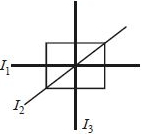
Consider a thin uniform square sheet made of a rigid material. If its side is $‘a’$ mass $m$ and moment of inertia $I$ about one of its diagonals, then
  • A
    $I > \frac{{m{a^2}}}{{12}}$
  • B
    $\frac{{m{a^2}}}{{24}} < I < \frac{{m{a^2}}}{{12}}$
  • C
    $I = \frac{{m{a^2}}}{{24}}$
  • $I = \frac{{m{a^2}}}{{12}}$

Answer

Correct option: D.
$I = \frac{{m{a^2}}}{{12}}$
d
For a thin uniform square sheet

${I_1} = {I_2} = {I_3} = \frac{{m{a^2}}}{{12}}$

Need a full question paper?

Generate a complete, print-ready paper with questions like this in minutes — across 16+ boards, with answer keys.

Start Generating Free

Similar questions

A triatomic, diatomic and monatomic gas is supplied same amount of heat at constant pressure, then
The value of restitution coefficient e for perfectly elastic collision is:
Consider a bowl filled with water on which some black pepper powder have been sprinkled uniformly. Now, a drop of liquid soap is added at the centre of the surface of water. The picture of the surface immediately after this will look like
A road is $10\, m$ wide. Its radius of curvature is $50\, m$. The outer edge is above the lower edge by a distance of $1.5\, m$. This road is most suited for the velocity ..........  $m/\sec$
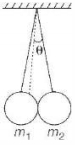
Two spherical objects each of radii $R$ and masses $m_1$ and $m_2$ are suspended using two strings of equal length $L$ as shown in the figure $(R << L)$. The angle $\theta$ which mass $m_2$ makes with the vertical is approximately
Two stars emit maximum radiation at wavelength $3600Å$ and $4800Å$ respectively. The ratio of their temperatures is
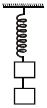
Two small bodies of mass of $2\, kg$ each attached to each other using a thread of length $10\, cm$, hang on a spring whose force constant is $200\, N/m$, as shown in the figure. We burn the thread. What is the distance between the two bodies when the top body first arrives at its highest position .... $cm$ ? (Take $\pi^2 = 10$)
Which of the following particles will experience maximum magnetic force circle when projected with the same velocity perpendicular to a magnetic field?
A body of mass $2\, kg$ moving with a velocity $\left( {\hat i + \hat j + \hat k} \right)\,m/s$ collides with another body of mass $5\, kg$ moving with velocity $\left( {\hat i - 2\hat j + 3\hat k} \right)\,m/s$. If they stick together, the velocity (in $m/s$) of the composite body is 
Two resistors ${R}_{1}=(4 \pm 0.8) \Omega$ and ${R}_{2}=(4 \pm 0.4)$ $\Omega$ are connected in parallel. The equivalent resistance of their parallel combination will be