MCQ
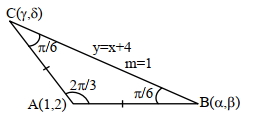
Consider a triangle $\mathrm{ABC}$ having the vertices $\mathrm{A}(1,2), \mathrm{B}(\alpha, \beta)$ and $\mathrm{C}(\gamma, \delta)$ and angles $\angle \mathrm{ABC}=\frac{\pi}{6}$ and $\angle \mathrm{BAC}=\frac{2 \pi}{3}$. If the points $\mathrm{B}$ and $\mathrm{C}$ lie on the line $\mathrm{y}=\mathrm{x}+4$, then $\alpha^2+\gamma^2$ is equal to....................
  • A
    $46$
  • B
    $13$
  • C
    $15$
  • $14$

Answer

Correct option: D.
$14$
d
Equation of line passes through point $\mathrm{A}(1,2)$ which makes angle $\frac{\pi}{6}$ from $y=x+4$ is

$ \mathrm{y}-2=\frac{1 \pm \tan \frac{\pi}{6}}{1 \mp \tan \frac{\pi}{6}}(\mathrm{x}-1) $

$ \mathrm{y}-2=\frac{\sqrt{3} \pm 1}{\sqrt{3} \mp 1}(\mathrm{x}-1)$

$\oplus$                                                           

$y-2=(2+\sqrt{3})(x-1) $

solve with $ y=x+4 $

$x+2=(2+\sqrt{3}) x-2-\sqrt{3} $

$x=\frac{4+\sqrt{3}}{1+\sqrt{3}}$

$\Theta$

$y-2=(2-\sqrt{3})(x-1)$

solve with $\mathrm{y}=\mathrm{x}+4$

$x+2=(2-\sqrt{3}) x-2+\sqrt{3} $

$x=\frac{4-\sqrt{3}}{1-\sqrt{3}}$

$ \alpha^2+\gamma^2=\left(\frac{4+\sqrt{3}}{1+\sqrt{3}}\right)^2+\left(\frac{4-\sqrt{3}}{1-\sqrt{3}}\right)^2 $

$ \alpha^2+\gamma^2=14$

Need a full question paper?

Generate a complete, print-ready paper with questions like this in minutes — across 16+ boards, with answer keys.

Start Generating Free