MCQ
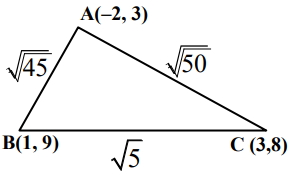
Consider a triangle having vertices $A(-2,3), B(1,9)$ and $C(3,8)$. If a line $L$ passing through the circum-center of triangle $\mathrm{ABC}$, bisects line $\mathrm{BC}$, and intersects $\mathrm{y}$-axis at point $\left(0, \frac{\alpha}{2}\right)$, then the value of real number $\alpha$ is $.....$
  • A
    $81$
  • B
    $3$
  • $9$
  • D
    $45$

Answer

Correct option: C.
$9$
c
$(\sqrt{50})^{2}=(\sqrt{45})^{2}+(\sqrt{5})^{2}$

$\angle \mathrm{B}=90^{\circ}$

$\text { Circum-center }=\left(\frac{1}{2}, \frac{11}{2}\right)$

Mid point of $B C=\left(2, \frac{17}{2}\right)$

Line $:\left(y-\frac{11}{2}\right)=2\left(x-\frac{1}{2}\right) \Rightarrow y=2 x+\frac{9}{2}$

Passing through $\left(0, \frac{\alpha}{2}\right)$

$\frac{\alpha}{2}=\frac{9}{2} \Rightarrow \alpha=9$

Need a full question paper?

Generate a complete, print-ready paper with questions like this in minutes — across 16+ boards, with answer keys.

Start Generating Free

Similar questions

The shortest distance between line $y -x = 1$ and curve $x = y^2$ is
Let $s , t , r$ be non-zero complex numbers and $L$ be the set of solutions $z=x+i y(x, y \in R , i=\sqrt{-1})$ of the equation $s z+t \bar{z}+r=0$ and $\bar{z}=x-i y$. Then, which of the following statement(s) is (are) $TRUE$?

$(A)$ If $L$ has exactly one element, then $|s| \neq|t|$

$(B)$ If $|s|=|t|$, then $L$ has infinitely many elements

$(C)$ The number of elements in $L \cap\{z:|z-1+i|=5\}$ is at most $2$

$(D)$ If $L$ has more than one element, then $L$ has infinitely many elements

The slope of the tangent to the curve $\left(y-x^5\right)^2=x\left(1+x^2\right)^2$ at the point $(1,3)$ is
If the common tangent to the parabolas, $y ^{2}=4 x$ and $x ^{2}=4 y$ also touches the circle, $x^{2}+y^{2}=c^{2},$ then $c$ is equal to
A horse runs along a circle with a speed of $20 km/hr$ . A lantern is at the centre of the circle . A fence is along the tangent to the circle at the point at which the horse starts . The speed with which the shadow of the horse move along the fence at the moment when it covers $1/8$ of the circle in $km/hr$ is
For all values of $\theta $, the locus of the point of intersection of the lines $x\cos \theta + y\sin \theta = a$ and $x\sin \theta - y\cos \theta = b$ is
Let $A=\left\{\theta \in R \mid \cos ^2(\sin \theta)+\sin ^2(\cos \theta)=1\right\}$ and $B=\{\theta \in R \mid \cos (\sin \theta) \sin (\cos \theta)=0\}$. Then, $A \cap B$ 
Consider the relations $R_1$ and $R_2$ defined as $a R_1 b \Leftrightarrow a^2+b^2=1$ for all $a, b, \in R$ and $(a, b) R_2(c, d) \Leftrightarrow a+d=b+c$ for all $(a, b),(c, d) \in N \times N$. Then
The most general value of $\theta $ satisfying the equations $\tan \theta = - 1$ and $\cos \theta = \frac{1}{{\sqrt 2 }}$ is
Consider three boxes, each containing $10$ balls labelled $1, 2, ….., 10$. Suppose one ball is randomly drawn from each of the boxes. Denote by $n_i$, the label of the ball drawn from the $i^{th}$ box, $(i = 1, 2, 3)$. Then, the number of ways in which the balls can be chosen such that $n_1 < n_2 < n_3$ is: