Question
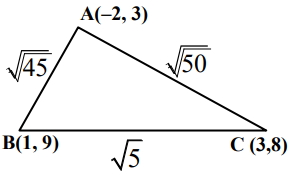
Consider a triangle having vertices $A(-2,3), B(1,9)$ and $C(3,8)$. If a line $L$ passing through the circum-center of triangle $\mathrm{ABC}$, bisects line $\mathrm{BC}$, and intersects $\mathrm{y}$-axis at point $\left(0, \frac{\alpha}{2}\right)$, then the value of real number $\alpha$ is $.....$
Answer

c
$(\sqrt{50})^{2}=(\sqrt{45})^{2}+(\sqrt{5})^{2}$

$\angle \mathrm{B}=90^{\circ}$

$\text { Circum-center }=\left(\frac{1}{2}, \frac{11}{2}\right)$

Mid point of $B C=\left(2, \frac{17}{2}\right)$

Line $:\left(y-\frac{11}{2}\right)=2\left(x-\frac{1}{2}\right) \Rightarrow y=2 x+\frac{9}{2}$

Passing through $\left(0, \frac{\alpha}{2}\right)$

$\frac{\alpha}{2}=\frac{9}{2} \Rightarrow \alpha=9$

Need a full question paper?

Generate a complete, print-ready paper with questions like this in minutes — across 16+ boards, with answer keys.

Start Generating Free

Similar questions

The number of terms common between the two series $2 + 5 + 8 +.....$ upto $50$ terms and the series $3 + 5 + 7 + 9.....$ upto $60$ terms, is
${\sec ^{ - 1}}[\sec ( - {30^o})] = $ ....... $^o$
If the vectors $a\,i - 2j + 3k$ and $3i + 6j - 5k$ are perpendicular to each other, then $ a $ is given by
The smallest natural number $n,$ such that the coefficient of $x$ in the expansion of ${\left( {{x^2}\, + \,\frac{1}{{{x^3}}}} \right)^n}$ is $^n{C_{23}}$ is
The value of $(0.16)^{\log _{2.5}\left(\frac{1}{3}+\frac{1}{3^{2}}+\frac{1}{3^{3}}+\ldots . to \infty\right)}$ is equal to
If $u = {x^2} + {y^2}$ and $x = s + 3t,$$y = 2s - t,$ then ${{{d^2}u} \over {d{s^2}}} = $
Let $\vec u\;$be a vector coplanar with the vector  $\vec a = 2\hat i + 3\hat j - \hat k$ and $\vec b = \hat j + \hat k$ . If  $\vec u$ is perpendicular to $\vec a$ and $\vec u \cdot \vec b = 24$ ,then ${\left| {\vec u} \right|^2} = $ . . . .
The number of terms of the $A.P. 3,7,11,15...$ to be taken so that the sum is $406$ is
Let $\lambda, \mu \in R$. If the system of equations

$ 3 x+5 y+\lambda z=3 $

$ 7 x+11 y-9 z=2 $

$ 97 x+155 y-189 z=\mu$

has infinitely many solutions, then $\mu+2 \lambda$ is equal to :

Ten trucks, numbered $1$ to $10$ , are carrying packets of sugar. Each packet weights either $999\,g$ or $1000\,g$ and each truck carries only the packets equal weights. The combined weight of $1$ packet selected from the first truck,$2$ packets from the second,$4$ packets from the third, and so on, and $2^9$ packet from the tenth truck is $1022870\,g$. The trucks that have the lighter bags are