MCQ
Consider a uniform electric field in the $\hat{\text{Z}}$ direction. The potential is a constant:
- AIn all space.
- BFor any x for a given z.
- CFor any y for a given z.
- DOn the x-y plane for a given z.
We know, the electric field intensity E and electric potential V are
$\text{E}=-\frac{\text{dV}}{\text{dr}}$
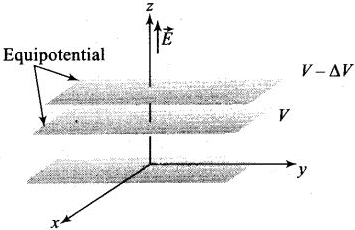
Electric potential decreases inf the direction of electric field. The direction of electric field is always perpendicular to one equipotential surface maintained at high electrostatic potential to other equipotential surface maintained at low electrostatic potential.
The electric field in z-direction suggest that equipotential surfaces are in x-y plane. Therefore the potential is a constant for any x for a given z, for any y for a given z and on the x-y plane for a given z.
Generate a complete, print-ready paper with questions like this in minutes — across 16+ boards, with answer keys.
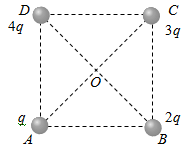
Charges q, 2q, 3q and 4q are placed at the corners A, B, C and D of a square as shown in the following figure. The direction of electric field at the centre of the square is along
|
(a) AB |
(b) CB |
(c) BD |
(d) AC |
A circular metal plate of radius R is rotating with a uniform angular velocity ω with its plane perpendicular to a uniform magnetic field B. Then the emf developed between the centre and the rim of the plate is
|
(a) πω |
(b) ω |
(c) πω |
(d) ω |
The plates of a capacitor are charged to a potential difference of 320 volts and are then connected across a resistor. The potential difference across the capacitor decays exponentially with time. After 1 second the potential difference between the plates of the capacitor is 240 volts, then after 2 and 3 seconds the potential difference between the plates will be
|
(a) 200 and 180 V |
(b) 180 and 135 V |
(c) 160 and 80 V |
(d) 140 and 20 V |
Photo cells are used for the
|
(a) Reproduction of pictures from the cinema film |
|
(b) Reproduction of sound from the cinema film |
|
(c) Automatic switching of street light |
|
(d) (b) and (c) both |
$\frac{\text{mv}^2}{\text{r}}$ must be acting on the central particle.
$\frac{2\text{mv}^2}{\text{r}}$ must be acting on the central particle.
$\frac{2\text{mv}^2}{\text{r}}$ must be acting on the system.
$\frac{2\text{mv}^2}{\text{r}}$ must be acting on the ring.
If a rod has resistance 4 W and if rod is turned as half cycle then the resistance along diameter
|
(a) 1.56 W |
(b) 2.44 W |
(c) 4 W |
(d) 2 W |
A battery of 6 volts is connected to the terminals of a three metre long wire of uniform thickness and resistance of the order of 100 Ω. The difference of potential between two points separated by 50 cm on the wire will be
|
(a) 1 V |
(b) 1.5 V |
(c) 2 V |
(d) 3 V |

