Question
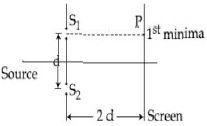
Consider a Young’s double slit experiment as shown in figure. What should be the slit separation $d$ in terms of wavelength $\lambda $ such that the first minima occurs directly in front of the slit $(S_1)$?
Answer

$\sqrt{(2 d)^{2}+(d)^{2}}-2 d=\frac{\lambda}{2}$

$\Rightarrow \quad(\sqrt{5}-2) d=\frac{\lambda}{2}$

$\Rightarrow \quad d=\frac{\lambda}{2(\sqrt{5}-2)}$

Need a full question paper?

Generate a complete, print-ready paper with questions like this in minutes — across 16+ boards, with answer keys.

Start Generating Free

Similar questions

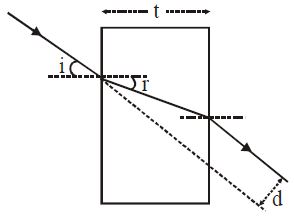
A ray of light is incident on a thick slab of glass of thickness $t$ as shown in the figure.  The  emergent ray is parallel to the incident ray but displaced sideways by a distance $d$. If  the angles are small then $d$ is
A $p-n$ photodiode is made of a material with a band gap of $2.0\, eV$. The minimum frequency of the radiation that can be absorbed by the material is nearly
Two bodies $A$ and $B$ collide as shown in Fig. $(i)$ and $(ii)$ Which statement is true ?
Which is the correct diagram of a half-wave rectifier
An inductance coil have the time constant $4\, sec$, if it is cut into two equal parts and connected parallel then new time constant of the circuit.....$sec$
A particle $(\mathrm{m}=1\; \mathrm{kg})$ slides down a frictionless track $(AOC)$ starting from rest at a point $A$ (height $2\; \mathrm{m}$ ). After reaching $\mathrm{C}$, the particle continues to move freely in air as a projectile. When it reaching its highest point $P$ (height $1 \;\mathrm{m}$ ). the kinetic energy of the particle (in $\mathrm{J}$ ) is : (Figure drawn is schematic and not to scale; take $\left.g=10 \;\mathrm{ms}^{-2}\right)$
Given below are two statements:

Statement $(I)$: When an object is placed at the centre of curvature of a concave lens, image is formed at the centre of curvature of the lens on the other side.

Statement $(II)$: Concave lens always forms a virtual and erect image.

In the light of the above statements, choose the correct answer from the options given below:

Operational amplifier is a
The balls, having linear momenta $\vec{p}_1=\hat{p} \hat{i}$ and $\vec{p}_2=-p \hat{i}$, undergo a collision in free space. There is no external force acting on the balls. Let $\vec{p}_1^{\prime}$ and $\vec{p}_2^{\prime}$ be their final momenta. The following option$(s)$ is (are) $NOT ALLOWED$ for any non-zero value of $\mathrm{p}, \mathrm{a}_1, \mathrm{a}_2, \mathrm{~b}_1, \mathrm{~b}_2, \mathrm{c}_1$ and $\mathrm{c}_2$.

$(A)$ $ \overrightarrow{\mathrm{p}}_1^{\prime}=\mathrm{a}_1 \hat{\mathrm{i}}+\mathrm{b}_1 \hat{\mathrm{j}}+\mathrm{c}_1 \hat{\mathrm{k}} $

$ \overrightarrow{\mathrm{p}}_2^{\prime}=\mathrm{a}_2 \hat{\mathrm{i}}+\mathrm{b}_2 \hat{\mathrm{j}}$

$(B)$ $ \overrightarrow{\mathrm{p}}_1^{\prime}=\mathrm{c}_1 \hat{\mathrm{k}} $

$ \overrightarrow{\mathrm{p}}_2^{\prime}=\mathrm{c}_2 \hat{\mathrm{k}}$

$(C)$ $ \overrightarrow{\mathrm{p}}_1^{\prime}=\mathrm{a}_1 \hat{\mathrm{i}}+\mathrm{b}_1 \hat{\mathrm{j}}+\mathrm{c}_1 \hat{\mathrm{k}} $

$ \overrightarrow{\mathrm{p}}_2=\mathrm{a}_2 \hat{\mathrm{i}}+\mathrm{b}_2 \hat{\mathrm{j}}-\mathrm{c}_1 \hat{\mathrm{k}}$

$(D)$ $ \vec{p}_1^{\prime}=a_1 \hat{i}+b_1 \hat{j} $

$ \overrightarrow{\mathrm{p}}_2^{\prime}=a_2 \hat{\mathrm{i}}+b_1 \hat{\mathrm{j}}$

A small ball of mass $M$ and density $\rho$ is dropped in a viscous liquid of density $\rho_0$. After some time, the ball falls with a constant velocity. What is the viscous force on the ball ?