Question
Consider an excited hydrogen atom in state $n$ moving with a velocity $u(ν << c)$. It emits a photon in the direction of its motion and changes its state to a lower state $m$. Apply momentum and energy conservation principles to calculate the frequency $ν$ of the emitted radiation. Compare this with the frequency $ν_0$ emitted if the atom were at rest.
Answer

Velocity of hydrogen atom in state $‘n’ = u$
Also the velocity of photon $= u$
But $u << C$
Here the photon is emitted as a wave.
So its velocity is same as that of hydrogen atom i.e. $u$.
$\therefore$ Accounding to Doppler’s effect,
Frequency $\text{v}=\text{v}_0\bigg(\frac{1+\frac{\text{u}}{\text{c}}}{1-\frac{\text{u}}{\text{c}}}\bigg)$
as $u <<< C$
$1-\frac{\text{u}}{\text{c}}=\text{q}$
$\therefore\ \text{v}=\text{v}_0\bigg(\frac{1+\frac{\text{u}}{\text{c}}}{1}\bigg)=\text{v}_0\Big(1+\frac{\text{u}}{\text{c}}\Big)$
$\text{v}=\text{v}_0\Big(1+\frac{\text{u}}{\text{c}}\Big)$

Need a full question paper?

Generate a complete, print-ready paper with questions like this in minutes — across 16+ boards, with answer keys.

Start Generating Free

Similar questions

A solenoid $60 \ cm$ long and of radius $4.0 \ cm$ has $3$ layers of windings of $300$ turns each.$ A 2.0 \ cm$ long wire of mass $2.5 g$ lies inside the solenoid $($near its centre$)$ normal to its axis; both the wire and the axis of the solenoid are in the horizontal plane. The wire is connected through two leads parallel to the axis of the solenoid to an external battery which supplies a current of $6.0 A$ in the wire. What value of current $($with appropriate sense of circulation$)$ in the windings of the solenoid can support the weight of the wire? $g = 9.8 m s^{–2}.$
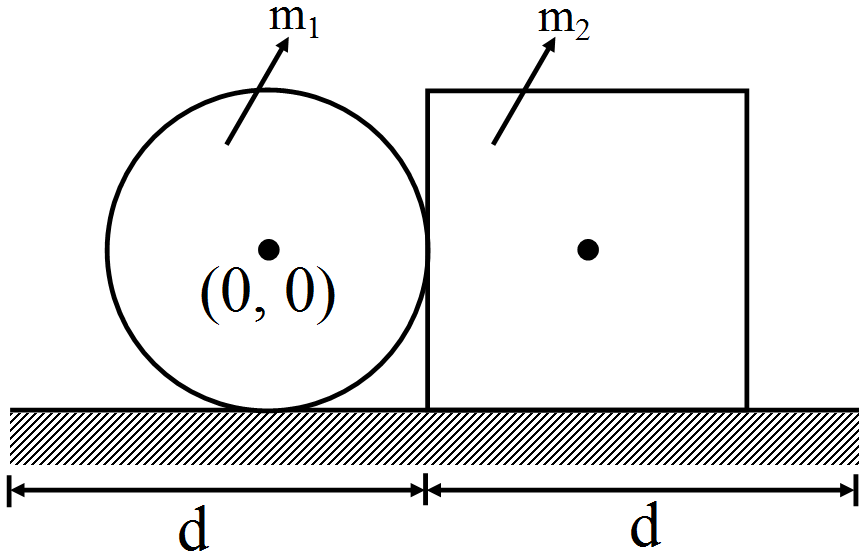
A square plate of edge d and a circular disc of diameter d are placed touching each other at the midpoint of an edge of the plate as shown in figure. Locate the centre of mass of the combination, assuming same mass per unit area for the two plates.
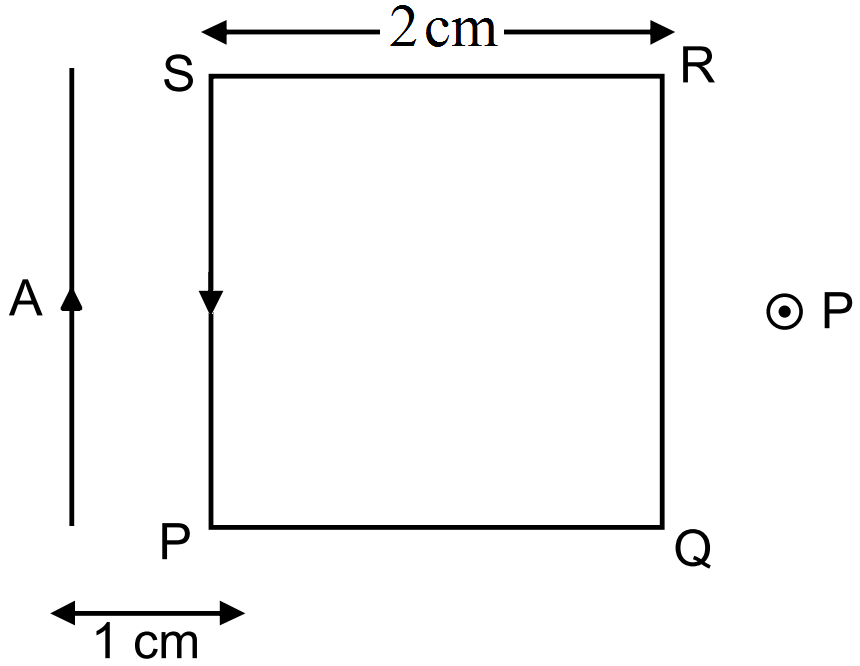
A square loop PQRS carrying a current of 6.0A is placed near a long wire carrying 10A as shown in figure.
  1. Show that the magnetic force acting on the part PQ is equal and opposite to that on the part RS. 
  2. Find the magnetic force on the square loop.
When a horse pulls a cart, the force that helps the horse to move forward is the force exerted by:
  1. The cart on the horse.
  2. The ground on the horse.
  3. The ground on the cart.
  4. The horse on the ground.
What do you understand by sensitivity and efficiency of a galvanometer? On which factors does it depend?
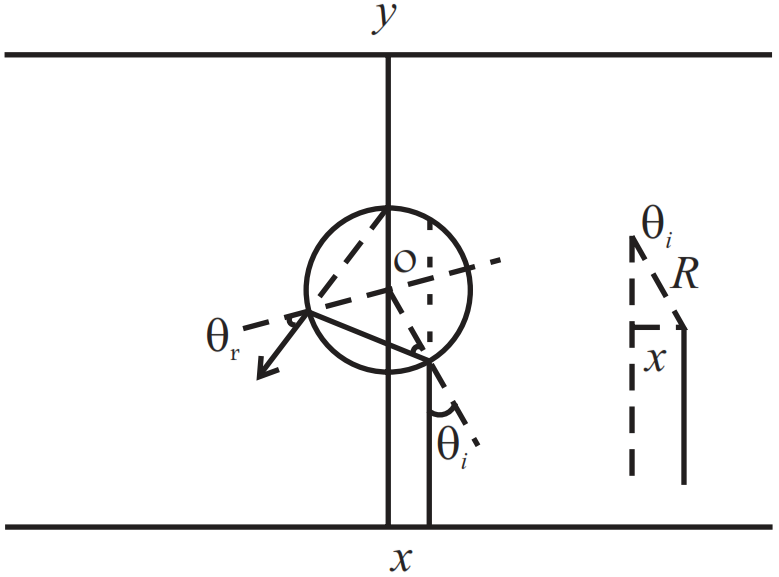
An infinitely long cylinder of radius R is made of an unusual exotic material with refractive index -1 (Fig). The cylinder is placed between two planes whose normals are along the y direction. The center of the cylinder O lies along the y-axis. A narrow laser beam is directed along the y direction from the lower plate. The laser source is at a horizontal distance x from the diameter in the y direction. Find the range of x such that light emitted from the lower plane does not reach the upper plane.
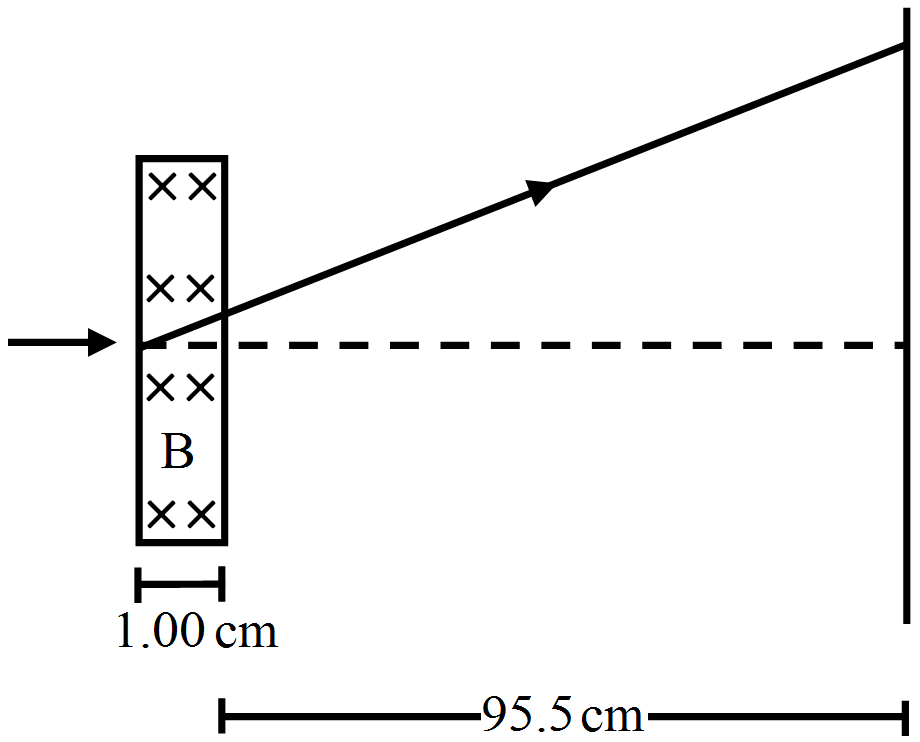
A narrow beam of singly charged potassium ions of kinetic energy $32\ keV$ is injected into a region of width $1.00\ cm$ with a magnetic field of strength $0.500T,$ as shown in the figure. The ions are collected at a screen $95.5\ cm$ away from the field region. If the beam contains isotopes of atomic weights $39$ and $41,$ find the separation between the points where these isotopes strike the screen. Take the mass of a potassium ion $= A (1.6 \times 10^{-27})\ kg,$ where $A$ is the mass number.
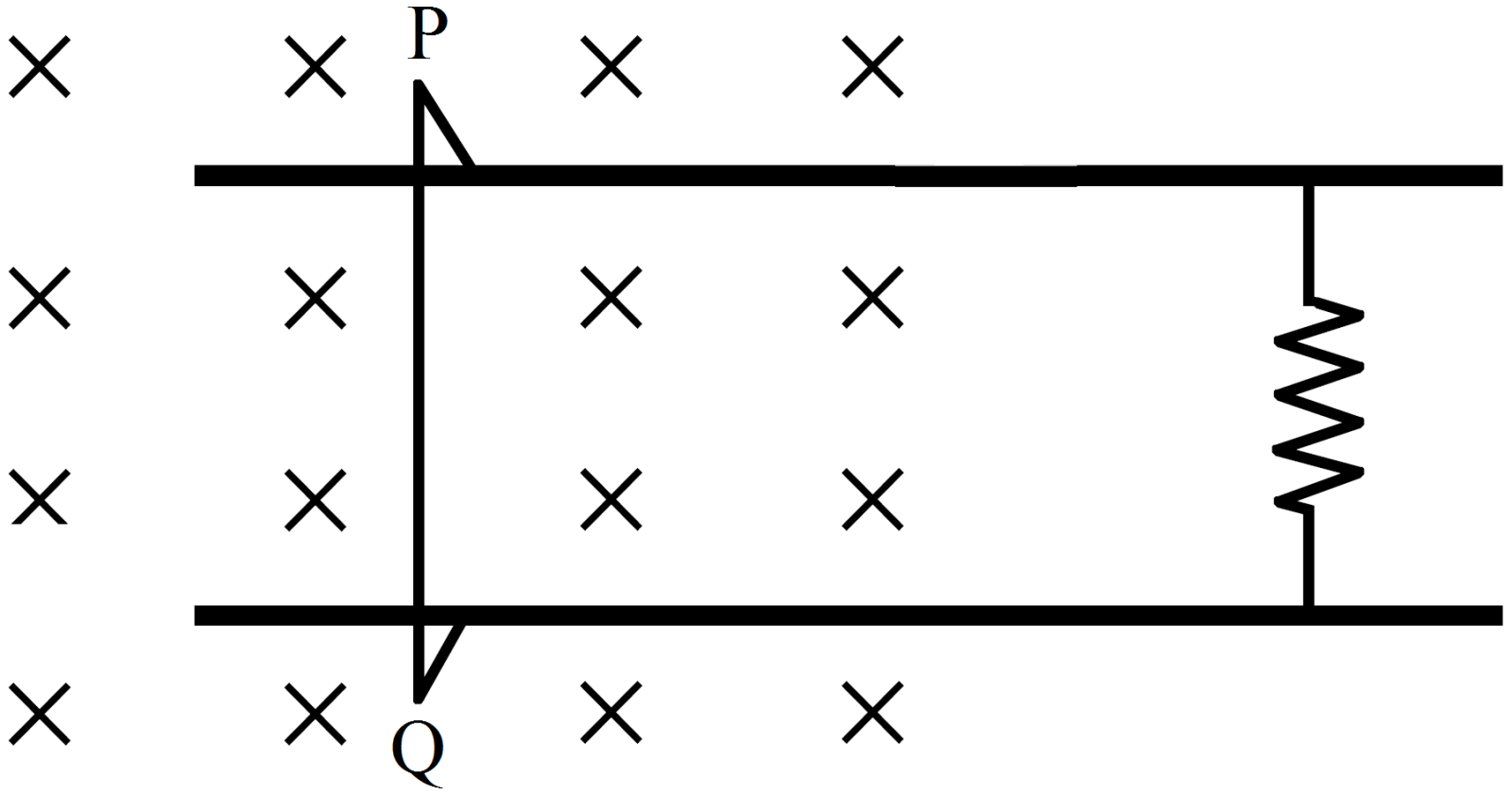
Consider the situation shown in figure. The wire $PQ$ has mass $m,$ resistance $r$ and can slide on the smooth, horizontal parallel rails separated by a distance $l.$ The resistance of the rails is negligible. A uniform magnetic field $B$ exists in the rectangular region and a resistance $R$ connects the rails outside the field region. At $t = 0,$ the wire $PQ$ is pushed towards right with a speed $v_0.$ Find
  1. The current in the loop at an instant when the speed of the wire $PQ$ is $v.$
  2. The acceleration of the wire at this instant.
  3. The velocity vas a functions of $x.$
  4. The maximum distance the wire will move.
In $1959$ Lyttleton and Bondi suggested that the expansion of the Universe could be explained if matter carried a net charge. Suppose that the Universe is made up of hydrogen atoms with a number density $N,$ which is maintained a constant. Let the charge on the proton be: $\ce{e_p = -(1 + y)e}$ where e is the electronic charge.
Find the critical value of $y$ such that expansion may start.
A particle stays at rest as seen in a frame. We can conclude that:
  1. The frame is inertial.
  2. Resultant force on the particle is zero.
  3. The frame may be inertial but the resultant force on the particle is zero.
  4. The frame may be non-inertial but there is a non-zero resultant force.