MCQ

Consider an extended object immersed in water contained in a plane trough. When seen from close to the edge of the trough the object looks distorted because:

  • A
    The apparent depth of the points close to the edge are nearer the surface of the water compared to the points away from the edge.
  • B
    The angle subtended by the image of the object at the eye is smaller than the actual angle subtended by the object in air.
  • C
    Some of the points of the object far away from the edge may not be visible because of total internal reflection.
  • D
    Water in a trough acts as a lens and magnifies the object.
Answer

  1. The apparent depth of the points close to the edge are nearer the surface of the water compared to the points away from the edge.
  2. The angle subtended by the image of the object at the eye is smaller than the actual angle subtended by the object in air.
  3. Some of the points of the object far away from the edge may not be visible because of total internal reflection.

Solution:

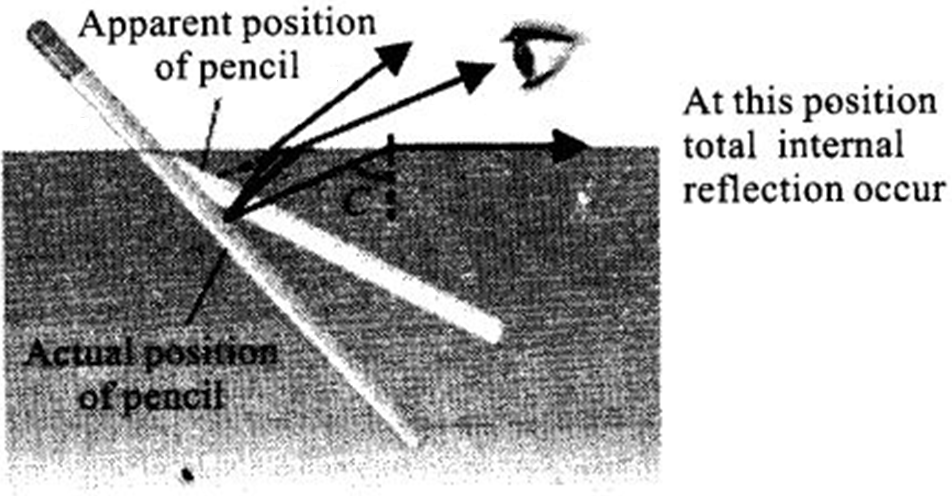
Key concept: The light from the pencil is refracted when it passes from the water into air, bending away from the normal as it moves from high to low refractive index.

When light from the submerged object before reaching to the observer gets, refracted from water surface, the rays bend away from normal and the angle subtended by the image of the object at the eye is smaller than the actual angle subtended by the object in air. Also the apparent depth of the .points close to the edge are nearer the surface of the water compared to the points away from the edge.

As we move towards right, the angle of incident increases and becomes equal to critical angle. Hence some of the points of the object far away from the edge may not be visible because of total internal reflection.

Need a full question paper?

Generate a complete, print-ready paper with questions like this in minutes — across 16+ boards, with answer keys.

Start Generating Free

Similar questions

An ideal gas goes from the state i to the state fas shown in figure. The work done by the gas during the process:
  1. Is positive.
  2. Is negative.
  3. Is zero.
  4. Cannot be obtained from this information.

A particle is acted upon by a force of constant magnitude which is always perpendicular to the velocity of the particle. The motion of the particle takes place in a plane. It follows that:
  1. Its velocity is constant.
  2. Its acceleration is constant.
  3. Its kinetic energy is constant.
  4. It moves in a circular path.

The image which can be obtained on a screen is called:

An ammeter of 5 ohm resistance can read 5 mA. If it is to be used to read 100 volts, how much resistance is to be connected in series

(a) 19.9995 Ω

(b) 199.995 Ω

(c) 1999.95 Ω

(d) 19995 Ω

Which of the following pairs of physical quantities may be represented in the same unit?
  1. Heat and temperature.
  2. Temperature and mole.
  3. Heat and work.
  4. Specific heat and heat.

The de-Broglie wavelength of a particle moving with a velocity 2.25 × 10⁸ m/s is equal to the wavelength of photon. The ratio of kinetic energy of the particle to the energy of the photon is (velocity of light is 3 × 10⁸ m/s)

(a) 1/8

(b) 3/8

(c) 5/8

(d) 7/8

................. gave the principle of Electromagnetic Induction.

Consider an optical communication system operating at l~ 800 nm. Suppose, only 1% of the optical source frequency is the available channel bandwidth for optical communication. How many channels can be accommodated for transmitting audio signals requiring a bandwidth of 8 kHz

(a) 4.8 × 10⁸

(b) 48

(c) 6.2 × 10⁸  

(d) 4.8 × 10⁵

Which one is not the correct statement

(a) 1 volt × 1 coulomb = 1 joule

(b) 1 volt × 1 ampere = 1 joule/second

(c) 1 volt × 1 watt = 1 H.P.

(d) Watt-hour can be expressed in eV

A white light is passed through the two narrow slits and produced a pattern of alternating bright and dark lines on the screen as shown above. What will effects on the central bright band , if the distance between screen and slits are increased?