Question
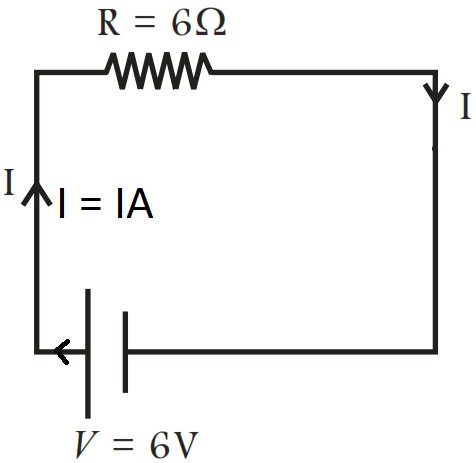
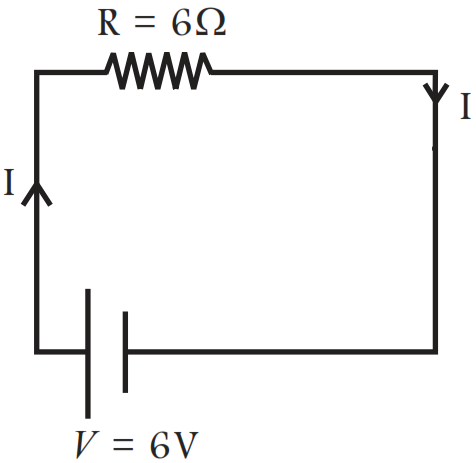
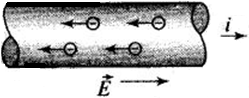
Consider circuit in Fig. How much energy is absorbed by electrons from the initial state of no current $($ignore thermal motion$)$ to the state of drift velocity?
Answer

Key concept : Relation between current and drift velocity is given by $I =$ ne $Av_d,$
where vd is the drift speed of electrons and n is the number density of electrons.

According to the $Ohm'$ s law current in the circuit

$\text{I}=\frac{\text{V}}{\text{R}}$
$\text{I}=\frac{6\text{V}}{6\Omega}=1\text{A}$
But, $\text{I}=\text{neAv}_\text{d}$
or $\text{v}_\text{d}=\frac{\text{I}}{\text{neA}}$
On substituting the value,
For $n =$ number of electrons/volume $= 10^{29}/m^3$
length of circuit $= 10\ cm$, cross $-$ section $= A = (1mm)^2$
$\text{v}_\text{d}=\frac{1}{10^{29}\times16\times10^{-19}\times10^{-6}}$
$=\frac{1}{1.6}\times10^{-4}\text{m/s}$
Therefore, the energy absorbed in the form of $KE$ is given by
Total $KE = KE$ of $1$ electron $\times$ on. of electrons
$\text{KE}=\frac{1}{2}\text{m}_\text{e}\text{v}_\text{d}^2\times\text{nAl}$
$=\frac{1}{2}\times9.1\times10^{31}\times\frac{1}{2.56}\times10^{-8}\times{10}^{29}\times{10}^{-6}\times10^{-1}$
$=2\times10^{-17}\text{J}$

Need a full question paper?

Generate a complete, print-ready paper with questions like this in minutes — across 16+ boards, with answer keys.
Start Generating Free

Similar questions

A particle is observed from two frames $S_1$ and. $S_2.$ The frame $S_{2 }$ moves with respect to $S_{1 }$ with an acceleration $a$. Let $F_1$ and $F_2$ be the pseudo forces on the particle when seen from $S_1$ and $S_2$ respectively. Which of the following are not possible?
Obtain expression for root mean square value of alternating emf. Draw graph between $E$ and t and $E ^2$ and $t$ and prove that average rate of heat produced for alternating current in one complete cycle is $H = I _{\text {max }}^2 R$.
The circuit in Fig. shows two cells connected in opposition to each other. Cell $E_1$ is of emf $6V$ and internal resistance $2\Omega$ ; the cell $E_2$ is of emf $4V$ and internal resistance $8\Omega$ . Find the potential difference between the points $A$ and $B$.
Why does blowing over a spoonful of hot tea cools it? Does evaporation play a role? Does radiation play a role?
A uniform rod of length L rests against a smooth roller as shown in figure. Find the friction coefficient between the ground and the lower end if the minimum angle that the rod can make with the horizontal is $\theta.$
The deuteron is bound by nuclear forces just as H-atom is made up of p and e bound by electrostatic forces. If we consider the force between neutron and proton in deuteron as given in the form of a Coulomb potential but with an effective charge e':
$\text{F}=\frac{1}{4\pi\epsilon_0}\frac{\text{e}'^2}{\text{r}}$
estimate the value of (e’/e) given that the binding energy of a deuteron is 2.2MeV.
  1. Draw the circuit arrangement for studying the input and output characteristics of an $n-p-n$ transistor in $CE$ configuration. With the help of these characteristics define $(i)$ input resistance $, (ii)$ current amplification factor.
  2. Describe briefly with the help of a circuit diagram how an $n-p-n$ transistor is used to produce self-sustained oscillations.
Describe the procedure for obtaining V-I characteristic curve in forward bias of P-N junction diode. Make a circuit diagram of the experimental arrangement.
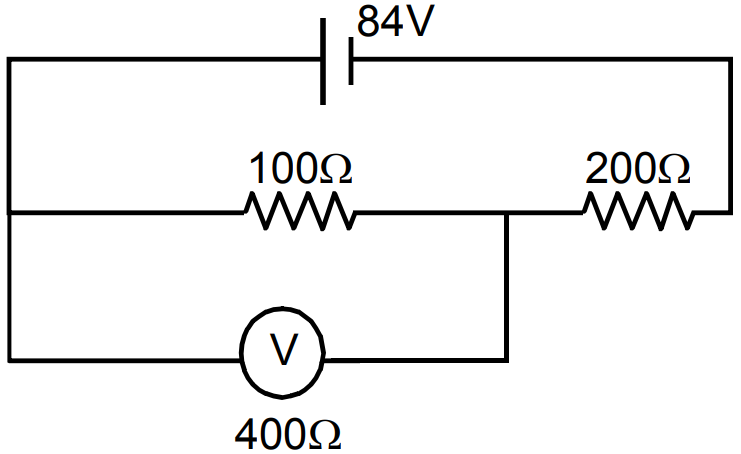
A voltmeter of resistance $400\Omega$ is used to measure the potential difference across the $100\Omega$ resistor in the circuit shown in the figure. (a) What will be the reading of the voltmeter? (b) What was the potential difference across $100\Omega$ before the voltmeter was connected?
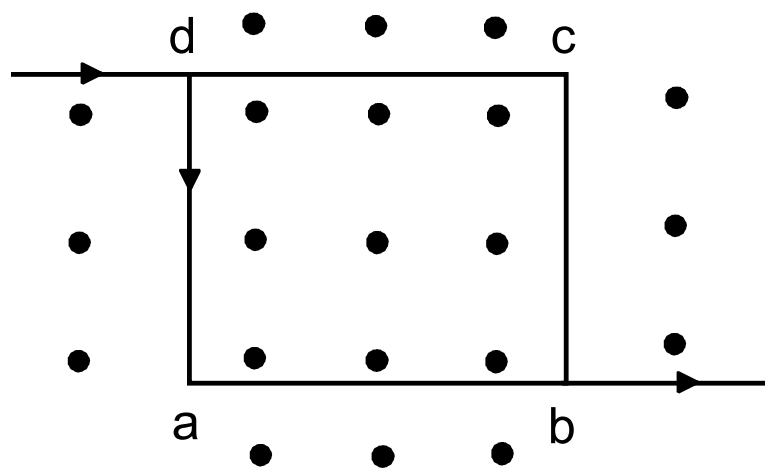
A current of 2A enters at the corner d of a square frame abcd of side 20cm and leaves at the opposite corner b. A magnetic field B = 0.1 T exists in the space in a direction perpendicular to the plane of the frame, as shown in the figure. Find the magnitude and direction of the magnetic forces on the four sides of the frame.