MCQ
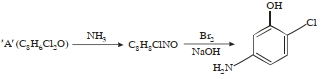
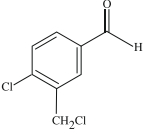
Consider the above reaction, the compound $'A'$ is
- A
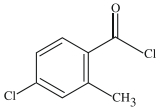
- B
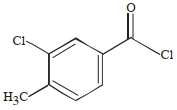
- ✓
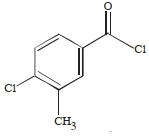
- D
Generate a complete, print-ready paper with questions like this in minutes — across 16+ boards, with answer keys.
|
LIST $I$ (Compound) |
LIST $II$ (Uses) |
| $A$ Iodoform | $I$ Fire extinguisher |
| $B$ Carbon tetrachloride | $II$ Insecticide |
| $C$ $CFC$ | $III$ Antiseptic |
| $D$ $DDT$ | $IV$ Refrigerants |
Choose the correct answer from the options given below :
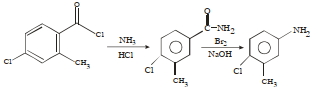
In the above reaction $A, B$ and $C $ are the following compounds
$\mathrm{V}^{2+}(\mathrm{aq})+2 \mathrm{e}^{-} \rightarrow \mathrm{V} \ \ \ \ \mathrm{E}^0=-1.19 \mathrm{~V} $
$\mathrm{Fe}^{3+}(\mathrm{aq})+3 \mathrm{e}^{-} \rightarrow \mathrm{Fe} \ \ \ \ \mathrm{E}^0=-0.04 \mathrm{~V} $
$\mathrm{Au}^{3+}(\mathrm{aq})+3 \mathrm{e}^{-} \rightarrow \mathrm{Au} \ \ \ \ \mathrm{E}^0=+1.40 \mathrm{~V} $
$\mathrm{Hg}^{2+}(\mathrm{aq})+2 \mathrm{e}^{-} \rightarrow \mathrm{Hg} \ \ \ \ \mathrm{E}^0=+0.86 \mathrm{~V}$
The pair$(s)$ of metals that is$(are)$ oxidized by $\mathrm{NO}_3^{-}$in aqueous solution is$(are)$
$(A)$ $\mathrm{V}$ and $\mathrm{Hg}$ $(B)$ $\mathrm{Hg}$ and $\mathrm{Fe}$
$(C)$ $\mathrm{Fe}$ and $\mathrm{Au}$ $(D)$ $Fe$ and $V$
Product in above reaction is