Question
Consider the circuit shown in figure:
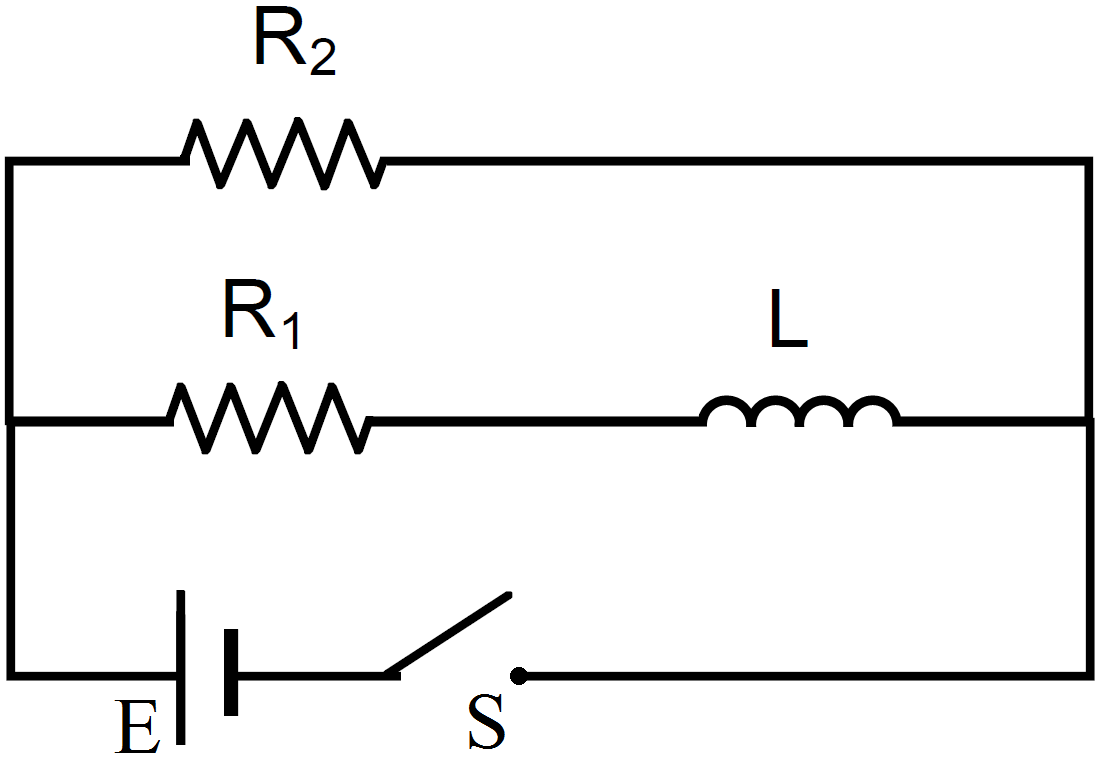
  1. Find the current through the battery a long time after the switch S is closed.
  2. Suppose the switch is again opened at t = 0. What is the time constant of the discharging circuit?
  3. Find the current through the inductor after one time constant.
Answer

  1. Because the switch is closed, the battery gets connected across the L‒R circuit. The current in the L‒R circuit after t seconds after connecting the battery is given by
$\text{i}=\text{i}_0\Big(\text{e}^{\frac{-\text{t}}{\tau}}\Big)$
$i_0=$ Steady state current
$\tau=$ Time constant $=\frac{\text{L}}{\text{R}}$
After a long time, $\text{t}\rightarrow\infty$
Now,
Current in the inductor, $i = i_0 (1 - e^0) = 0$
Thus, the effect of inductance vanishes.
$\text{i}=\frac{\text{E}}{\text{R}_{\text{net}}}$
$=\frac{\in}{\frac{\text{R}_1\times\text{R}_2}{\text{R}_1+\text{R}_2}}=\frac{\in\big(\text{R}_1+\text{R}_2\big)}{\text{R}_1\text{R}_2}$
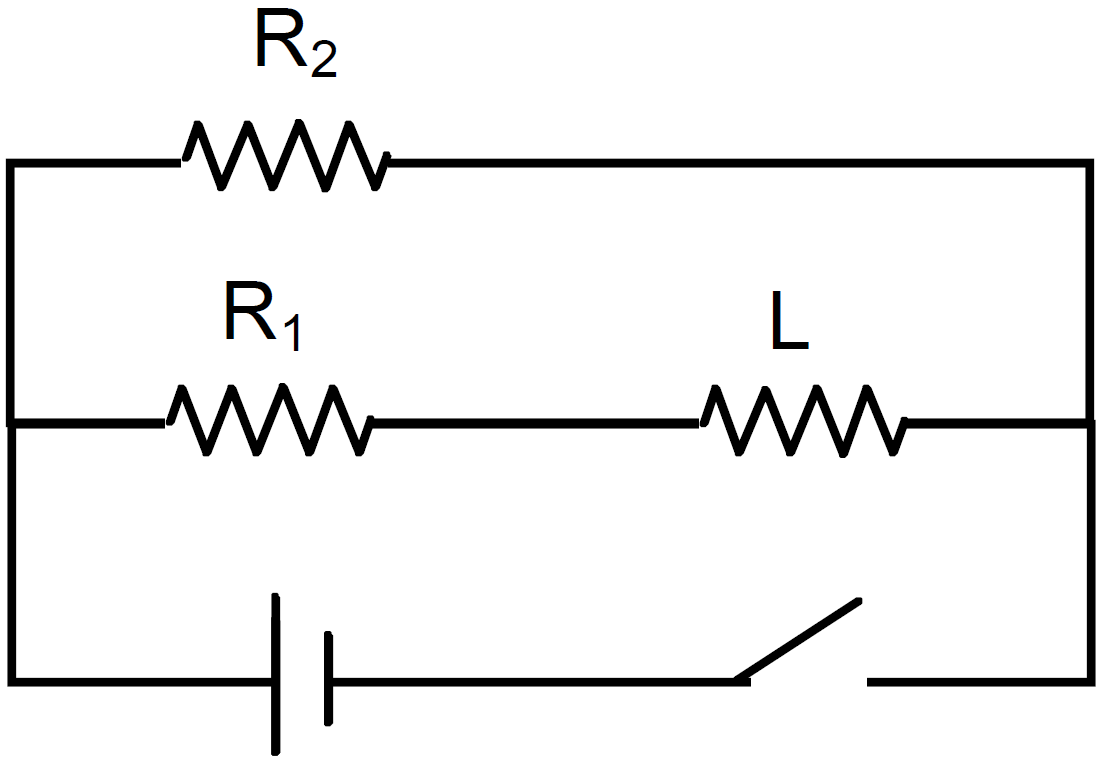
  1. When the switch is opened the resistors are in series.
The time constant is given by
$\tau=\frac{\text{L}}{\text{R}_\text{net}}=\frac{\text{L}}{\text{R}_1+\text{R}_2}.$
  1. The inductor will discharge through resistors $R_1$ and $R_2.$
The current through the inductor after one time constant is given by
$\text{t}=\tau$
$\therefore$ Current, $\text{i}=\text{i}_0\Big(\text{e}^{\frac{-\text{t}}{\tau}}\Big)$
Here,
$\text{i}_0=\frac{\in}{\text{R}_1+{\text{R}_2}}$
$\therefore \ \text{i}=\frac{\in}{\text{R}_1+{\text{R}_2}}\times\frac{1}{\text{e}}$

Need a full question paper?

Generate a complete, print-ready paper with questions like this in minutes — across 16+ boards, with answer keys.

Start Generating Free

Similar questions

An inductor of inductance 2.00H is joined in series with a resistor of resistance $200\Omega$ and a battery of emf 2.00V. At t = 10ms, find
  1. The current in the circuit.
  2. The power delivered by the battery.
  3. The power dissipated in heating the resistor.
  4. The rate at which energy is being stored in magnetic field.
The figure shows a cylindrical container containing oxygen $(\gamma=1.4)$ and closed by a 50kg frictionless piston. The area of cross section is $100cm^2$, atmospheric pressure is 100kPa and g is $10m-s^{−2}$. The cylinder is slowly heated for some time. Find the amount of heat supplied to the gas if the piston moves out through a distance of 20cm.
There are two sources of light, each emitting with a power of 100W. One emits X-rays of wavelength 1nm and the other visible light at 500nm. Find the ratio of number of photons of X-rays to the photons of visible light of the given wavelength?
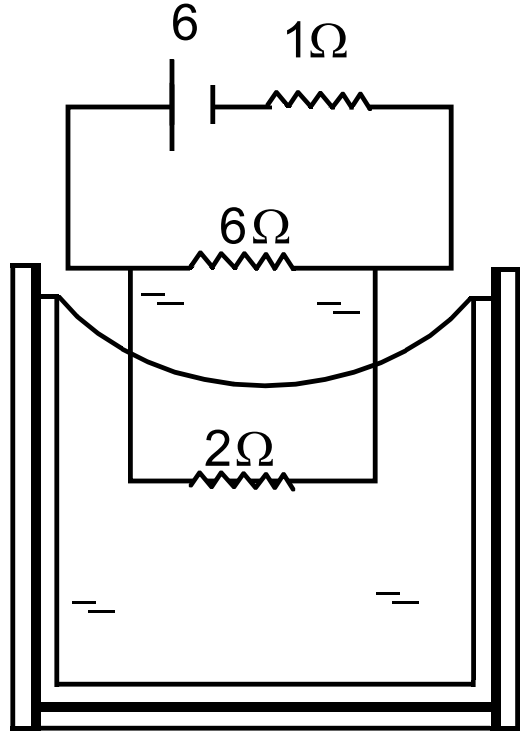
The 2.0Ω resistor shown in the figure is dipped into a calorimeter containing water. The heat capacity of the calorimeter together with water is $2000JK^{-1}.$
  1. If the circuit is active for 15 minutes, what would be the rise in the temperature of the water?
  2. Suppose the 6.0Ω resistor gets burnt. What would be the rise in the temperature of the water in the next 15 minutes?
The wavelengths of $\text{K}_\alpha$ and $\text{L}_\alpha$ X-rays of a material are 21.3pm and 141pm respectively. Find the wavelength of $\text{K}_\beta$ X-ray of the material.
A neutron star has a density equal to that of the nuclear matter. Assuming the star to be spherical, find the radius of a neutron star whose mass is $4.0 \times 10^{30}kg$ (twice the mass of the sun).
A capacitor of capacitance $C_1$ is charged to a potential $V_1$ while another capacitor of capacitance $C_2$ is charged to a potential difference $V_2$. The capacitors are now disconnected from their respective charging batteries and connected in parallel to each other.
$i.$ Find the total energy stored in the two capacitors before they are connected.
$ii.$ Find the total energy stored in the parallel combination of two capacitors.
$iii.$ Explain the reason for the difference of energy in parallel combination in comparison to the total energy before they are connected
Consider a particle moving in simple harmonic motion according to the equation $\text{x}=2.0\cos(50\pi\text{t}+\tan^{-1}0.75)$ where x is in centimetre and t in second. The motion is started at $t = 0.$
  1. When does the particle come to rest for the first time?
  2. When does the acceleration have its maximum magnitude for the first time?
  3. When does the particle come to rest for the second time?
A particle stays at rest as seen in a frame. We can conclude that:
  1. The frame is inertial.
  2. Resultant force on the particle is zero.
  3. The frame may be inertial but the resultant force on the particle is zero.
  4. The frame may be non-inertial but there is a non-zero resultant force.
An empty plastic box of mass m is found to accelerate up at the rate of $\frac{\text{g}}{6}$ when placed deep inside water. How much sand should be put inside the box so that it may accelerate down at the rate of $\frac{\text{g}}{6}?$