Question
Consider the compounds, $BCl_3$ and $CCl_4$. How will they behave with water? Justify.

Answer

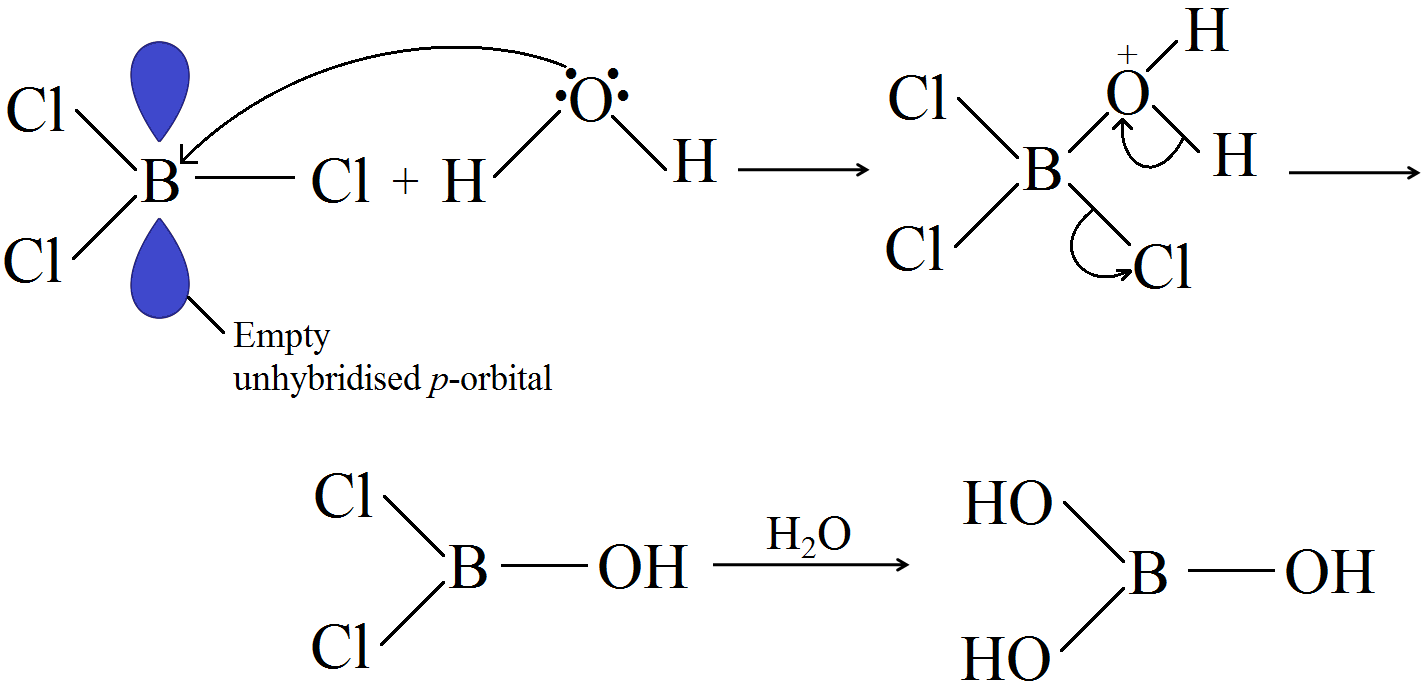
$BCl_3$ is an electron deficient compound. Also, it has an empty unhybridised p-orbital which can accept electrons. In presence of water, $BCl_3$ hydrolyses and forms $B(OH)_3$.

But, when $CCl_4$ is mixed with water, no reaction takes place because carbon neither has any unhybridised, empty p-orbital where it can accommodate electrons from water nor it has empty d-orbital.
$CCl_4 + H_2O$ → No reaction.

Need a full question paper?

Generate a complete, print-ready paper with questions like this in minutes — across 16+ boards, with answer keys.
Start Generating Free

Similar questions

  1. Heat(q) and work done (W) individually are not state functions but their sum is always a state function. Explain why?
  2. Calculate the standard enthalpy change $(\Delta_\text{r}\text{H}^\theta)$ and standard internal energy change $(\Delta_\text{r}\text{U}^\theta)$ for the following reaction at 300K:
$OF_2(g) + H_2O(g) + O_2(g) + 2HF(g)$
Standard enthalpy of formation $(\Delta_\text{r}\text{H}^\theta)$ of e n various species are given below:
$\Delta_\text{f}\text{H}^\theta\text{kJ mol}^{-1}: OF_2(g) = 23.0, H_2O(g)= -241.8, HF(g) = -268.6, R = 8.314 JK^{-1}mol^{-1}$.
What is the wavelength of light emitted when the electron in a hydrogen atom undergoes transition from an energy level with $n = 4$ to an energy level with $n = 2$?
An equilibrium mixture at 300K contains $N_2O_4$ and $NO_2$​​​​​​​ at 0.28 and 1.1atm pressure respectively. If the volume of the container is doubled, calculate the new equilibrium pressure of two gases.
Balance the following ionic equations. $\text{MnO}^{-}_4+\text{SO}^{2-}_3+\text{H}^+\xrightarrow{ \ \ \ \ \ \ \ \ \ }\text{Mn}^{2+}+\text{SO}^{2-}_4+\text{H}_2\text{O}$
When a mixture of ammonium chloride and potassium dichromate was heated, a stable colourless gas ‘A’ is evolved which did not support combustion, but Mg continued burning in it. The gas reacted with $CaC_2$ in electric furnace forming a solid 'B'. Which was slowly hydrolysed by water forming a insoluble substance 'C' and a solution of substance 'D' which turns red litmus blue and gives white fumes with conc HCl to form ‘E'. Identify A to E and write chemical reactions involved.
Nitrogen has positive electron gain enthalpy whereas oxygen has negative. However, oxygen has lower ionisation enthalpy than nitrogen. Explain.
Give a brief description of the principles of the following techniques taking an example in each case.
Crystallisation
Have you ever observed any water pollution in your area? What measures would you suggest to control it?
What are significant figures? State rules to determine it.
  1. Write the conjugate acid of $NH_3$.
  2. Assign reason for the following:
  1. A solution of $NH_4Cl$ in water shows pH less than 7.
  2. In qualitative analysis $NH_4Cl$ is added before adding $NH_4OH$ for testing $Fe^{3+}$ or $AP^{3+}$ ions.
  1. Consider the reaction:
$\text{N}_2(\text{g})+3\text{H}_2\text{(g)}\rightleftharpoons2\text{NH}_3+\text{Heat}$
Indicate the direction in which the equilibrium will shift when:
  1. Temperature is increased.
  2. Pressure is increased.