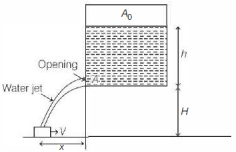
Consider the configuration of a stationary water tank of cross-section area $A_{0}$ and a small bucket as shown in figure below; the speed $v$ is .......... $m/s$ of the bucket, so that the water leaking out of a hole of cross-section area $A$ (as shown) from the water tank does not fall outside the bucket? (Take, $h=5 \,m , H=5 \,m , g=10 \,m / s ^{2}, A=5 \,cm ^{2}$ and $\left.A_{0}=500 \,cm ^{2}\right)$.
KVPY 2019, Advanced
Download our app for free and get started
$(c)$ Velocity of outflow (efflux) from hole
$=\sqrt{2 g h} \text {. }$
Range of water jet,
$x=\sqrt{2 g h} \times \text { Time of fall }$
$=\sqrt{2 g h} \times \frac{2 H}{\frac{2 H}{g}}=2 \sqrt{h H}$
Velocity $v$ of bucket is
$v=\frac{d x}{d t}=\frac{d}{d t} \cdot 2 \sqrt{h H}$
$=2 \sqrt{H} \cdot \frac{d \sqrt{h}}{d t}$
$\Rightarrow \quad v =2 \sqrt{H} \cdot \frac{1}{2 \sqrt{h}} \cdot \frac{d h}{d t}$
$=\sqrt{\frac{H}{h}} \cdot \frac{d h}{ d t}$ ............. $(i)$
Now, using equation of continuity at area $A_{0}$ and area $A$, we have
$A v_{1}=A_{0} V$
$\text { where, } v_{1} =\sqrt{2 g h}$
$\text { and } =\frac{d h}{d t}$
$\therefore A \sqrt{2 g h} =A_{0}\left(\frac{d h}{d t}\right)$
Substituting for $\frac{d h}{d t}$ from Eq $(i)$, we get
$v=\sqrt{\frac{H}{h}} \cdot \frac{A}{A_{0}} \cdot \sqrt{2 g h}$
$=\sqrt{\frac{5}{5}} \cdot\left(\frac{5}{500}\right) \cdot \sqrt{2 \times 10 \times 5}$
$=\frac{1}{10} \,ms ^{-1}$
$=0.1 \,ms ^{-1}$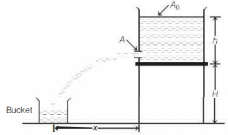

Download our appand get started for free
Experience the future of education. Simply download our apps or reach out to us for more information. Let's shape the future of learning together!No signup needed.*
Similar Questions
- 1The top of a water tank is open to air and its water level is maintained. It is giving out $0.74\,m^3$ water per minute through a circular opening of $2\,cm$ radius in its wall. The depth of the centre of the opening from the level of water in the tank is close to........ $m$View Solution
- 2The pressure at the bottom of a water tank is $4 P$. where $P$ is atmospheric pressure. If water is drawn out till the water level decreases by $\frac{3}{5}$ th, then pressure at the bottom of the tank is .........View Solution
- 3A uniform cylinder of length $L$ and mass $M$ having crosssectional area $A$ is suspended, with its length vertical, from a fixed point by a massless spring such that it is half submerged in a liquid of density $\sigma$ at equilibrium position. The extension $x_0$ of the spring when it is in equilibrium isView Solution
- 4View SolutionAir is blown through a hole on a closed pipe containing liquid. Then the pressure will
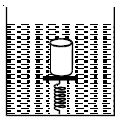
- 5A cylindrical block of area of cross-section $A$ and of material of density $\rho$ is placed in a liquid of density one-third of density of block. The block compresses a spring and compression in the spring is one-third of the length of the block. If acceleration due to gravity is $g$, the spring constant of the spring is:View Solution
- 6View SolutionA solid cube and a solid sphere both made of same material are completely submerged in water but to different depths. The sphere and the cube have same surface area. The buoyant force is
- 7View SolutionA beaker containing a liquid is kept inside a big closed jar. If the air inside the jar is continuously pumped out, the pressure in the liquid near the bottom of the liquid will
- 8View SolutionA cork is submerged in water by a spring attached to the bottom of a bowl. When the bowl is kept in an elevator moving with acceleration downwards, the length of spring
- 9A liquid of density $750\,kgm ^{-3}$ flows smoothly through a horizontal pipe that tapers in crosssectional area from $A _{1}=1.2 \times 10^{-2}\,m ^{2}$ to $A_{2}=\frac{A_{1}}{2}$. The pressure difference between the wide and narrow sections of the pipe is $4500\,Pa$. The rate of flow of liquid is________$\times 10^{-3}\,m ^{3} s ^{-1}$View Solution
- 10The two thigh bones (femurs), each of cross-sectional area $10\; cm ^{2}$ support the upper part of a human body of mass $40\; kg$. Estimate the average pressure sustained by the femurs.View Solution