MCQ
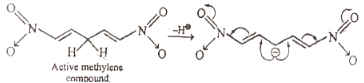
Consider 

The correct order of their acidity is 
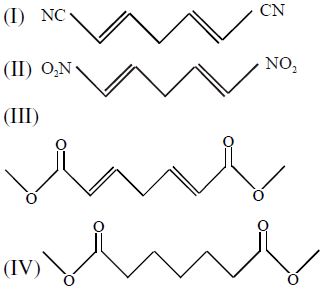
  • $II > I > III > IV$
  • B
    $II > III > I > IV$
  • C
    $IV > III > IV > I$
  • D
    None of these

Answer

Correct option: A.
$II > I > III > IV$
a

Need a full question paper?

Generate a complete, print-ready paper with questions like this in minutes — across 16+ boards, with answer keys.
Start Generating Free

Similar questions

The reaction of $HCOOH$ with conc. ${H_2}S{O_4}$ gives
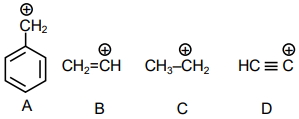
The correct order of stability of given carbocation is :
If period number and group number of any representative element $(s)$ are same then which of the following Statement is incorrect regarding such type element $(s)$ in their ground state?
(Period number and group number are according ro modern form of periodic table)
$0.8\, \mathrm{~g}$ of an organic compound was analysed by Kjeldahl's method for the estimation of nitrogen. If the percentage of nitrogen in the compound was found to be $42\, \%$, then $....\,\mathrm{mL}$ of $1\, \mathrm{M}$ $\mathrm{H}_{2} \mathrm{SO}_{4}$ would have been neutralized by the ammonia evolved during the analysis.
To measure the quantity of $MnCl _2$ dissolved in an aqueous solution, it was completely converted to $KMnO _4$ using the reaction,

$MnCl _2+ K _2 S _2 O _8+ H _2 O \longrightarrow KMnO _4+ H _2 SO _4+ HCl$ (equation not balanced).

Few drops of concentrated $HCl$ were added to this solution and gently warmed. Further, oxalic acid ( $225 mg$ ) was added in portions till the colour of the permanganate ion disappeared. The quantity of $MnCl _2$ (in $mg$ ) present in the initial solution is. . . . . . . . . (Atomic weights in $g mol ^{-1}: Mn =55, Cl =35.5$ )

The equilibrium constant $K_{c}$ at $298\, \mathrm{~K}$ for the reaction  $\mathrm{A}+\mathrm{B} \rightleftharpoons \mathrm{C}+\mathrm{D}$  is $100 .$ Starting with an equimolar solution with concentrations of $\mathrm{A}, \mathrm{B}, \mathrm{C}$ and $\mathrm{D}$ all equal to $1\, \mathrm{M}$, the equilibrium concentration of $D$ is $.......\times 10^{-2}$ M. (Nearest integer)
The number of moles of a gas in $1\, m^3$ of volume at $NTP$ is
Phenol $+$ Aniline $\xrightarrow[{KOH}]{{{C_6}{H_5}N_2^ + C{l^ - }}}$ Major Product $:$ Product will be $:$
Ammonium hydroxide is a weak base because
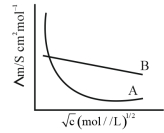
Following figure shows dependence of molar conductance of two electrolytes on concentration. $\Lambda \stackrel{0}{ m }$ is the limiting molar conductivity.The number of Incorrect statement(s) from the following is $...........$

$(A)$ $\Lambda \stackrel{0}{ m }$ for electrolyte $A$ is obtained by extrapolation

$(B)$ For electrolyte B, vx $\Lambda m$ vs $\sqrt{ c }$ graph is a straight line with intercept equal to $\Lambda \stackrel{0}{ m }$

$(C)$ At infinite dilution, the value of degree of dissociation approach zero for electrolyte $B$.

$(D)$ $\Lambda \stackrel{0}{ m }$ for any electrolyte $A$ or $B$ can be calculated using $\lambda^{\circ}$ for individual ions.