MCQ
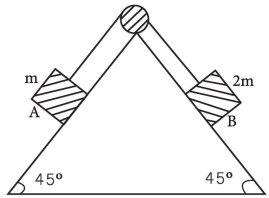
Consider the diagram shown below in which two masses of $m$ and $2 m$ are placed on a fixed triangular wedge. The coefficient of friction between block $A$ and the wedge is $2 / 3$, while that for block $B$ and the wedge is $1 / 3$
  • $zero$
  • B
    $\frac{2 m ^2}{3}\,g$
  • C
    $\frac{4 m ^2}{3}\,g$
  • D
    $\frac{ m ^2}{\sqrt{2}} g$

Answer

Correct option: A.
$zero$
a
(a)

Given,

$\mu_2=\frac{2}{3} \text { and } \mu_0=\frac{1}{3}$

Let the acceleration of the whole system be a then,

As per the diagram,

For block $B$,

$2 mg \cos 45^{\circ}+2 ma = T +\mu_0 N _{ b }$

$N _{ b }=2 mg \sin 45^{\circ}$

And, For block $A$,

$T =m g \cos 45^{\circ}+\mu_g N_a$

$N_{ a }=m g \sin 45^{\circ}$

So,

$T=m g \cos 45^{\circ}+\mu_2 m g \sin 45^{\circ} \ldots \ldots$

From eq $(1)$ and $(2)$

$2 m g \cos 45^{\circ}+2 ma =m g \cos 45^{\circ}+\mu_2 m g \sin 45^{\circ}+\mu_0 2 m g \sin 45^{\circ}$

After solving, We get $a =0$

So the acceleration of the block $A$ will be zero.

Need a full question paper?

Generate a complete, print-ready paper with questions like this in minutes — across 16+ boards, with answer keys.

Start Generating Free

Similar questions

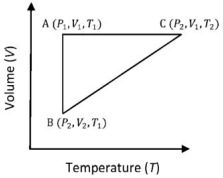
A reversible cyclic process for an ideal gas is shown below. Here, $P , V$, and $T$ are pressure, volume and temperature, respectively. The thermodynamic parameters $q, w, H$ and $U$ are heat, work, enthalpy and internal energy, respectively.

The correct option ($s$) is (are)

$(A)$ $q_{A C}=\Delta U_{B C}$ and $W_{A B}=P_2\left(V_2-V_1\right)$ $(B)$ $W _{ BC }= P _2\left( V _2- V _1\right)$ and $q _{ BC }= H _{ AC }$ $(C)$ $\Delta H _{ CA }<\Delta U _{ CA }$ and $q _{ AC }=\Delta U _{ BC }$ $(D)$ $q_{B C}=\Delta H_{A C}$ and $\Delta H_{C A}>\Delta U_{C A}$

Two small spherical metal balls, having equal masses, are made from materials of densities $\rho_{1}$ and $\rho_{2}\left(\rho_{1}=8 \rho_{2}\right)$ and have radii of $1\; \mathrm{mm}$ and $2\; \mathrm{mm}$, respectively. They are made to fall vertically (from rest) in a viscous medum whose coefficient of viscosity equals $\eta$ and whose denstry is $0.1 \mathrm{\rho}_{2} .$ The ratio of their terminal velocitites would be 
The magnitude of torque on a particle of mass $1\,kg$ is $2.5\, Nm$ about the origin. If the force acting on it is $1\,N$, and the distance of the particle from the origin is $5\,m$, the angle between the force and the position vector is (in radians)
Monoatomic, diatomic and triatomic gases whose initial volume and pressure are same, are compressed till their volume becomes half the initial volume.
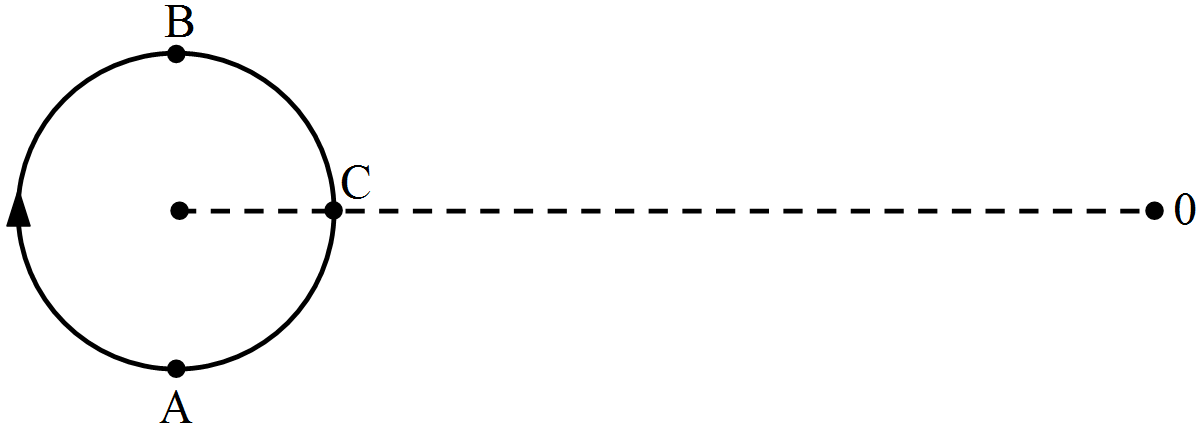
A small source of sound moves on a circle as shown$-$in figure and an observer is sitting at $0.$ Let $v_1, v_2, v_3$ be the frequencies heard when the source is at $A, B$ and $C$ respectively.

A bomb is dropped by fighter plane flying horizontally. To an observer sitting in the plane, the trajectory of the bomb is a :
A bag is gently dropped on a conveyor belt moving at a speed of $2\,m / s$. The coefficient of friction between the conveyor belt and bag is $0.4$ Initially, the bag slips on the belt before it stops due to friction. The distance travelled by the bag on the belt during slipping motion is $.....m$ [Take $g=10\,m / s ^{-2}$ ]
A conducting loop is placed in a uniform magnetic field with its plane perpendicular to the field. An $\text{emf}$ is induced in the loop if:
  1. It is translated.
  2. It is rotated about its axis.
  3. It is rotated about a diameter.
  4. It is deformed.
A bullet of mass $0.02\, kg$ travelling horizontally with velocity $250\, ms^{-1}$ strikes a block of wood of mass $0.23\, kg$ which rests on a rough horizontal surface. After the impact, the block and bullet move together and come to rest after travelling a distance of $40\,m$. The coefficient of sliding friction of the rough surface is $(g = 9.8\, ms^{-2})$
${\mu _0}$ and ${\varepsilon _0}$ denote the permeability and permittivity of free space, the dimensions of ${\mu _0}{\varepsilon _0}$ are