Question
Consider the equations

$\text{P}=\lim_\limits{\triangle\text{s}\rightarrow0}\frac{\text{F}}{\triangle\text{s}}$ and $\text{P}_1-\text{P}_2-\text{pgz}$

In an elevator accelerating upward.

  1. Both the equations are valid.
  2. The first is valid but not the second.
  3. The second is valid but not the first.
  4. Both are invalid.

Answer

  1. The first is valid but not the second.

For a point inside the elevator, pressure can be defined as $\text{P}=\lim_\limits{\triangle\text{s}\rightarrow0}\frac{\text{F}}{\triangle\text{s}}\cdot$ It is independent of the acceleration of the elevator.
The modified form of the second equation, which will be valid in the given case, is given.$\text{P}_1-\text{P}_2=\text{p}(\text{g}+\text{a}_0)\text{z}$
Here, acceleration a0(say) due to elevator accelerating upwards is also taken into account.

Need a full question paper?

Generate a complete, print-ready paper with questions like this in minutes — across 16+ boards, with answer keys.

Start Generating Free

Similar questions

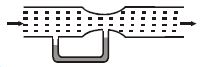
Water flows through the tube shown. Area of cross-section of wide and narrow part are $5$ $cm^2$ $\&$ $2$ $cm^2$. The rate of flow is $500$ $cm^3/sec$. Find difference in mercury level of $U-$ tube .......... $cm$
Three objects of same mass but different geometries, capable of rotating have radius of gyration as 0.2, 0.5 and 0.7. A torque is applied to these objects when they are rotating with constant angular velocity. Which object will have a larger response time for showing the change in their angular velocity:
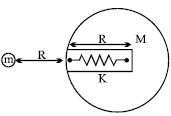
A small ball of mass $‘m’$ is released at a height $‘R’$ above the earth surface, as shown in the figure above. If the maximum depth of the ball to which it goes is $R/2$ inside the earth through a narrow grove before coming to rest momentarily. The grove, contain an ideal spring of spring constant $K$ and natural length $R,$ find the value of $K$ if $R$ is radius of earth and $M$ mass of earth
Consider the following statements about sound passing through a gas.
  1. The pressure of the gas at a point oscillates in time.
  2. The position of a small layer of the gas oscillates in time.
  1. Both A and B are correct.
  2. A is correct but B is wrong.
  3. B is correct but A is wrong.
  4. Both A and B are wrong.
A car is moving with a uniform speed on a level road. Inside the car there is a balloon filled with helium and attached to a piece of string tied to the floor. The string is observed to be vertical. The car now takes a left turn maintaining the speed on the level road. The balloon in the car will
A standing wave pattern of amplitude $A$ in a string of length $L$ shows $2$ nodes (plus those at two ends). If one end of the string corresponds to the origin and $v$ is the speed of progressive wave, the disturbance in the string, could be represented (with appropriate phase) as: 
There is no change in the volume of a wire due to change in its length on stretching. The poisson's ratio of the material of the wire is
The function of time representing a simple harmonic motion with a period of $\frac{\pi}{\omega}$ is :
$1\  mole$ of a gas with $\gamma$ = $7/5$ is mixed with $1\  mole$ of a gas with $\gamma$ = $5/3$, then the value of $\gamma$  for the resulting mixture is
A projectile is projected with speed $u$ at an angle $\theta$ with the horizontal. The average velocity of the projectile between the instants it crosses the same level is ............