MCQ
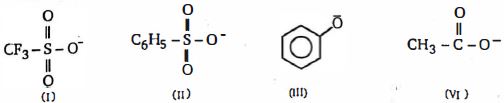
Consider the following anions. 

When attached to $sp^3$  -hybridized carbon, their leaving group ability in  nucleophilic substitution reaction decreases in the order
  • A
    $I > II > III > IV$
  • $I > II > IV > III$
  • C
    $IV > I > II > III$
  • D
    $IV > III > II > I$

Answer

Correct option: B.
$I > II > IV > III$
b
When attached to $sp ^3$-hybridized carbon, their leaving group ability in nucleophilic substitution reactions decreases in the order $I \,>\,II \,>\, IV \,>\, III$

$I$ is best leaving group due to electron withdrawing ($-I$) effect of trifluoromethyl group and delocalization of negative charge over $3 O$ atoms.

$III$ is worst leaving group because negative charge is delocalized over $C$ atoms.

The stabilization effect of resonance for the anion in which negative charge is delocalized over $O$ atoms is more pronounced over the delocalization in which the negative charge is delocalized over $C$ atoms.

$II$ is better leaving group than $IV$ because in $II$, the extent of delocalisation of negative charge is much more than the extent of delocalization in $IV$ .

Need a full question paper?

Generate a complete, print-ready paper with questions like this in minutes — across 16+ boards, with answer keys.

Start Generating Free

Similar questions

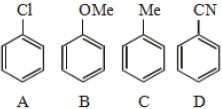
The increasing order of reactivity of the following compounds towards aromatic electrophilic substitution reaction is
At $298\, \mathrm{~K}$, the enthalpy of fusion of a solid $(\mathrm{X})$ is $2.8 \,\mathrm{k} \mathrm{J}\, \mathrm{mol}^{-1}$ and the enthalpy of vaporisation of the liquid $(X)$ is $98.2 \,\mathrm{~kJ}\, \mathrm{~mol}^{-1}$. The enthalpy of sublimation of the substance $(\mathrm{X})$ in $\mathrm{kJ} \,\mathrm{mol}^{-1}$ is $.....$ (in nearest integer)
The formation of alkene from alkyl halide is an example of
cis and trans $ 2-$butene are
According to Bohr's theory,

$\mathrm{E}_{\mathrm{n}}=$ Total energy, $\mathrm{K}_{\mathrm{n}}=$ Kinetic energy, $\mathrm{V}_{\mathrm{n}}=$ Potential energy , $\mathrm{r}_{\mathrm{n}}=$ Radius of $\mathrm{n}^{\text {th }}$ orbit

Match the following:

Column $I$ Column $II$
$(A)$ $\mathrm{V}_{\mathrm{n}} / \mathrm{K}_{\mathrm{n}}=$ ? $(P)$ $0$
$(B)$ If radius of $n^{\text {th }}$ orbit $\propto E_n^x, x=$ ? $(Q)$ $-1$
$(C)$ Angular momentum in lowest orbital $(R)$ $-2$
$(D)$ $\frac{1}{\mathrm{r}^{\mathrm{n}}} \propto \mathrm{Z}^{\mathrm{y}}, \mathrm{y}=$ ? $(S)$ $1$
${H_2}{O_{\left( g \right)}} + {C_{\left( s \right)}} \to C{O_{\left( g \right)}} + {H_2}\left( g \right)\,;\,\Delta H = 100\,kJ$

$C{O_{\left( g \right)}} + \frac{1}{2}{O_{2\left( g \right)}} \to C{O_{2\left( g \right)}}\,;\,\Delta H =  - 300\,kJ$

${H_2}_{\left( g \right)} + \frac{1}{2}{O_2}_{\left( g \right)} \to {H_2}{O_{\left( g \right)}}\,;\,\Delta H =  - 250\,kJ$

$C_{(s)} + O_{2(g)} \to  CO_{2(g)} ; \Delta H = -x\, kJ$

The value of $x$ will be

Anhydrous borax is:
Consider an imaginary ion ${ }_{22}^{48} X ^{3-}$. The nucleus contains 'a'$\%$ more neutrons than the number of electrons in the ion. The value of '$a$' is $.....$ [nearest integer]
In sulphur estimation. $0.471\,g$ of an organic compound gave $1.4439\,g$ of barium sulphate.The percentage of sulphur in the compound is $.............$(Nearest Integer)(Given: Atomic mass Ba: $137 u : S : 32 u , O : 16 u$ )
What is the change in the energy of system if 500 cal of heat energy are added to a system and system does 350 cal of work on the surroundings?