MCQ
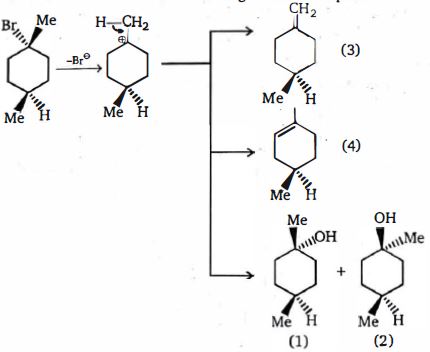
Consider the following $E_1 /S_{N^1}$ reaction 

The missing product $(s)$ is $(are)$
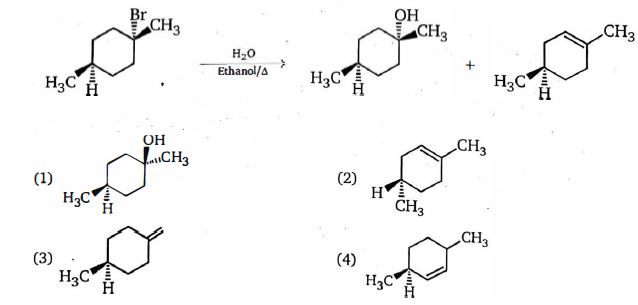
  • $1, 2$ and $3$
  • B
    $3$ and $4$
  • C
    $2$ and $3$
  • D
    $1, 2, 3$ and $4$

Answer

Correct option: A.
$1, 2$ and $3$
a

Need a full question paper?

Generate a complete, print-ready paper with questions like this in minutes — across 16+ boards, with answer keys.
Start Generating Free

Similar questions

The major reason that phenol is a better Bronsted acid than cyclohexanol is that
Following statements regarding the periodic trends of chemical reactivity of the alkali metals and the halogens are given. Which of these statements gives the correct picture?
Select correct statement $(s)$ regarding $[Ni(DMG)_2]$ complex compound
An organic liquid A containing $C,H$ and  $O$  has a pleasant odour with a boiling point of ${78\,^o}C$ On boiling A with conc. ${H_2}S{O_4}$ a colourless gas is produced which decolourises bromine water and alkaline $KMn{O_4}.$ One mole of this gas also takes one mole of ${H_2}.$ The organic liquid $ A$  is
Which of the following involves transfer of five electrons ?
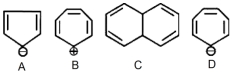
Which of the following structures are aromatic in nature?
Isomerism in saturated hydrocarbons is due to
When ethyne is passed through a red hot tube, then formation of benzene takes place :-

$\Delta H_{f({C_2}{H_2})(g)}^o\, = \,230\,kJ\,mo{l^{ - 1}}$

$\Delta H_{f({C_6}{H_6})(g)}^o\, = \,85\,kJ\,mo{l^{ - 1}}$

Calculate the standard heat of trimerisation of ethyne to benzene.

$3{C_2}{H_2}(g) \to {C_6}{H_6}(g)$ 

......$kJ\, mol^{-1}$

Consider the reaction at $300\, K$

${C_6}{H_6}\left( l \right) + \frac{{15}}{2}{O_2}\left( g \right) \longrightarrow 6C{O_2}\left( g \right) + 3{H_2}O\left( l \right)\,;\,\Delta H =  - 3271\,kJ$

What is $\Delta U$ for the combustion of $1.5\, mole$ of benzene at $27\,^oC$. .....$ kJ$

Which of the following has the lowest barrier to rotation about the indicated bond ?