MCQ
Consider the following

$I.$ Waves created on the surfaces of a water pond by a vibrating sources.

$II.$ Wave created by an oscillating electric field in air.

$III.$ Sound waves travelling under water.

Which of these can be polarized

  • A
    $I$ and $II$
  • $II$ only
  • C
    $II$ and $III$
  • D
    $I, II$ and $III$

Answer

Correct option: B.
$II$ only
b
(b)

Need a full question paper?

Generate a complete, print-ready paper with questions like this in minutes — across 16+ boards, with answer keys.

Start Generating Free

Similar questions

In an imaginary atmosphere, the air exerts a small force $F$ on any particle in the direction of the particle's motion. A particle of mass $m$ projected upward takes a time $t_1$ in reaching the maximum height and $t_2$ in the return journey to the original point. Then:
In kinetic theory of gases, it is assumed that molecules:
Given below are two statement 

Statement $-I$ : What $\mu$ amount of an ideal gas undergoes adiabatic change from state $\left( P _{1}, V _{1}, T _{1}\right)$ to state $\left( P _{2}, V _{2}, T _{2}\right)$, the work done is $W =\frac{1 R \left( T _{2}- T _{1}\right)}{1-\gamma}$, where $\gamma=\frac{ C _{ P }}{ C _{ V }}$ and $R =$ universal gas constant,

Statement $-II$ : In the above case. when work is done on the gas. the temperature of the gas would rise.

Choose the correct answer from the options given below

When the temperature of a rod increases from $t$ to $\left( {t + \Delta t} \right)$, its moment of inertia increases from $I$ to $\left( {I + \Delta I} \right)$. If $\alpha $ be the coefficient of linear expansion of the rod, then the value of $\left( {\frac{{\Delta I}}{I}} \right)$ is
A cubical block is floating in a liquid with half of its volume immersed in the liquid. When the whole system accelerates upwards with acceleration of $g/3,$  the fraction of volume immersed in the liquid will be
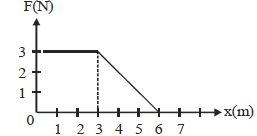
A force $F$ acting on an object varies with distance $x$ as shown here. The force is in $N$ and $x$ in $m$. The work done by the force in moving the object from $x = 0$ to $x = 6$ is ............. $\mathrm{J}$
A capillary tube $A$ is dipped in water. Another identical tube $B$ is dipped in soap$-$water solution. Which of the following shows the relative nature of the liquid columns in the two tubes?
If the velocity of a particle is $(10 + 2t^2) m/s$, then the average acceleration of the particle between $2s$ and $5s$ is..........$m/s^2$
To a person, going eastward in a car with a velocity of $25\, km/hr$, a train appears to move towards north with a velocity of $25\sqrt 3 $ $km/hr$. The actual velocity of the train will be..........$km/hr$
$A$ particle of mass $3m$ is projected from the ground at some angle with horizontal. The horizontal range is $R$. At the highest point of its path it breaks into two pieces $m$ and $2m$. The smaller mass comes to rest and larger mass finally falls at a distance $x$ from the point of projection where $x$ is equal to