MCQ
Consider the following sequence of reaction $A, B, C$ are

  • Benzene, Nitrobenzene and Aniline
  • B
    Benzene, Di-nitrobenzene and m-nitro aniline
  • C
    Benzene, Nitrobenzene and azoxy benzene
  • D
    Benzene, Nitrobenzene and Hydrazobenzene

Answer

Correct option: A.
Benzene, Nitrobenzene and Aniline
a

Need a full question paper?

Generate a complete, print-ready paper with questions like this in minutes — across 16+ boards, with answer keys.

Start Generating Free

Similar questions

$\underset{(A)}{\mathop{\begin{matrix}
   \,\,\,\,\,Ph\,\,\,\,C{{H}_{3}}  \\
   |\,\,\,\,\,\,\,\,\,\,|\,\,  \\
   Ph-C-C-C{{H}_{3}}  \\
   |\,\,\,\,\,\,\,\,\,\,|\,\,\,  \\
   \,OH\,\,\,OH  \\
\end{matrix}}}\,+\underset{(B)}{\mathop{\begin{matrix}
   \,\,\,\,Ph\,\,\,Et  \\
   \,\,|\,\,\,\,\,\,\,\,\,|  \\
   Ph-C-C-Et  \\
   \,\,|\,\,\,\,\,\,\,\,\,|  \\
   \,\,\,\,\,OH\,\,OH  \\
\end{matrix}}}\,\xrightarrow{{{H}_{2}}S{{O}_{4}}}$


$(p)$ $\begin{matrix}
   Ph\,\,\,\,\,O\,  \\
   |\,\,\,\,\,\,\,\,||\,\,  \\
   Ph-C-C-C{{H}_{3}}  \\
   |\,\,\,\,\,\,\,\,\,\,\,\,  \\
   C{{H}_{3}}\,\,\,\,\,\,\,\,  \\
\end{matrix}$                                $(q)$ $\begin{matrix}
   \,Ph\,\,\,\,\,O\,  \\
   \,\,|\,\,\,\,\,\,\,\,||  \\
   Ph-C-C-Et  \\
   |\,\,\,\,\,\,\,\,\,\,  \\
   Et\,\,\,\,\,\,\,\,\,\,  \\
\end{matrix}$

$(r)$ $\begin{matrix}
   \,Ph\,\,\,\,\,O\,  \\
   |\,\,\,\,\,\,\,\,\,\,||\,  \\
   Ph-C-C-C{{H}_{3}}  \\
   |\,\,\,\,\,\,\,\,\,\,\,\,\,\,  \\
   Et\,\,\,\,\,\,\,\,\,\,\,\,\,  \\
\end{matrix}$                             $(s)$ $\begin{matrix}
   \,\,\,Ph\,\,\,\,\,O\,  \\
   \,\,|\,\,\,\,\,\,\,\,||  \\
   Ph-C-C-Et  \\
   |\,\,\,\,\,\,\,\,\,\,  \\
   C{{H}_{3}}\,\,\,\,  \\
\end{matrix}$

When $(A)$ and $(B)$ reacts with $H_2SO_4$ products obtained are
A solution is $500\, ml$ of $2\, M \,KOH$ is added to $500\, ml$ of $2\, M \,HCl$ and the mixture is well shaken.The rise in temperature $T_1$ is noted. The experiment is then repeated using $250\, ml$ of each solution and rise in temperature $T_2$ is again noted. Assume all heat is taken by the solution
Which of the following has largest number of isomers ?
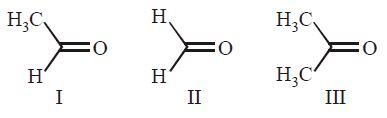
Rate of hydrate formation of the given compounds is 
Which one of the following complexes is an outer orbital complex

Atomic no. : $Mn = 25,\,Fe = 26,\,Co = 27,\,Ni = 28$

Which of the following can show geometrical isomerism :-
Given below are two statements:

Statement $I$: $\mathrm{PF}_5$ and $\mathrm{BrF}_5$ both exhibit $\mathrm{sp}^3 \mathrm{~d}$ hybridisation.

Statement $II$: Both $\mathrm{SF}_6$ and $\left[\mathrm{Co}\left(\mathrm{NH}_3\right)_6\right]^{3+}$ exhibit $\mathrm{sp}^3 \mathrm{~d}^2$ hybridisation.

In the light of the above statements, choose the correct answer from the options given below:

At $444\,^oC$ , the equilibrium constant $K$ for the reaction $2A{B_{(g)}} \rightleftharpoons {A_{2(g)}} + {B_{2(g)}}$ is $\frac {1}{64}$ . The degree of dissociation of $AB$ will be .....$\%$
Which compound will not undergo decarboxylation on heating ?
Rotation of plane polarised light is measured by