MCQ
Consider the following statements ( $X$ and $Y$ stand for two different elements):

$(I)$ ${ }_{32}^{65} X$ and ${ }_{33}^{65} Y$ are isotopes.

$(II)$ ${ }_{42}^{86} X$ and ${ }_{42}^{85} Y$ are isotopes.

$(III)$ ${ }_{85}^{174} X$ and ${ }_{88}^{177} Y$ have the same number of neutrons.

$(IV)$ ${ }_{92}^{235} X$ and ${ }_{94}^{235} Y$ are isobars.

Which of the above statements are correct?

  • A
    Only statements $II$ and $IV$ are correct
  • B
    Only statements $I, II$ and $IV$ are correct
  • Only statements $II, III$ and $IV$ are correct
  • D
    All statements are correct

Answer

Correct option: C.
Only statements $II, III$ and $IV$ are correct
c
(c)

For a nucleus, ${ }_Z^A X$

Mass number, $A=N+Z$

where, $N=$ number of neutrons

and $Z=$ number of protons.

In ${ }_{32}^{65} X$ and ${ }_{33}^{65} Y$, number of protons are different. So, these are not isotopes.

In ${ }_{42}^{86} X$ and ${ }_{42}^{85} Y$, number of protons are equal. So, these are isotopes.

In ${ }_{85}^{174} X$ and ${ }_{88}^{177} Y$, number of neutrons are $174-85=89$ and $177-88=89$.

So, both have same number of neutrons.

In ${ }_{92}^{235} X$ and ${ }_{94}^{235} Y$, both have same mass number, so these are isobars.

Need a full question paper?

Generate a complete, print-ready paper with questions like this in minutes — across 16+ boards, with answer keys.

Start Generating Free

Similar questions

An observer is riding on a bicycle and moving towards a hill at $18\,km\,h ^{-1}$. He hears a sound from a source at some distance behind him directly as well as after its reflection from the hill. If the original frequency of the sound as emitted by source is $640\,\,Hz$ and velocity of the sound in air is $320\,m / s$, the beat frequency between the two sounds heard by observer will be $...Hz$.
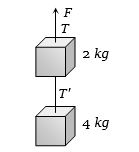
Two blocks are connected by a string as shown in the diagram. The upper block is hung by another string. A force $F$ applied on the upper string produces an acceleration of $2\,m/{s^2}$ in the upward direction in both the blocks. If $T$ and $T'$ be the tensions in the two parts of the string, then $T$ and $T'$
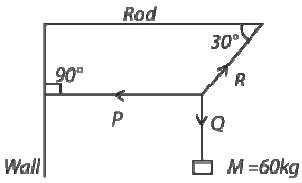
A body of mass $60\,kg$ is suspended by means of three strings $P, Q$ and $R$ as shown in the figure is in equilibrium. The tension in the string $P$ is $..........g\,N$
A $npn$ transistor is connected in common emitter configuration in a given amplifier. A load resistance of $800 \,\,\Omega$ is connected in the collector circuit and the voltage drop across it is $0.8\,\, V.$ If the current amplification factor is $0.96$ and the input resistance of the circuit is $192 \,\,\Omega$, the voltage gain and the power gain of the amplifier will respectively be
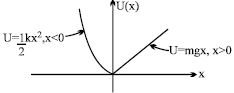
A particle of mass $m$ moves in the potential energy $U$ shown above. The period of the motion when the particle has total energy $E$ is
A convex lens of focal length $84 cm$ is in contact with a concave lens of focal length $12 cm.$ The power of combination (in diopters) is
If time of flight of a projectile is $10$ seconds. Range is $500$ meters. The maximum height attained by it will be  ......... $m$
A vehicle with a horn of frequency $n$ is moving with a velocity of $30\, m/s$ in a direction perpendicular to the straight line joining the observer and the vehicle. The observer perceives the sound to have a frequency $n + {n_1}$. Then (if the sound velocity in air is $300\, m/s$)
A particle of mass m moving with velocity ${V_0}$ strikes a simple pendulum of mass $m$ and sticks to it. The maximum height attained by the pendulum will be
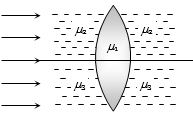
A double convex lens, lens made of a material of refractive index ${\mu _1}$, is placed inside two liquids or refractive indices ${\mu _2}$ and ${\mu _3}$, as shown. ${\mu _2} > {\mu _1} > {\mu _3}$. A wide, parallel beam of light is incident on the lens from the left. The lens will give rise to