Question
Consider the following supply schedule.
S. No.
Price (₹ per unit)
Quantity Supplied (in units)
i.
10
200
ii.
10
100
It is called:
  1. Decrease in supply.
  2. Decrease in quantity supplied.
  3. Decrease in demand.
  4. All of the above.

Answer

  1. Decrease in supply.

Need a full question paper?

Generate a complete, print-ready paper with questions like this in minutes — across 16+ boards, with answer keys.

Start Generating Free

Similar questions

Aggregate Supply = Consumption + _______
  1. Supply.
  2. Investment.
  3. Saving.
  4. Expenditure.
........ is the minimum rate at which Central Bank is prepared to give credit to the commercial banks:
  1. Repo rate.
  2. Reverse repo.
  3. CRR.
  4. SLR.
When Total Product falls, then _______________.
  1. Average Product is equal to zero.
  2. Marginal Product is equal to zero.
  3. Marginal Product is negative.
  4. Average Product continues to rise.
If budgetary deficit is nil and borrowings and other liabilities are 70 crore, what is the amount of fiscal deficit?
  1. Nil.
  2. 30 crore.
  3. Can't say.
  4. 70 crore.
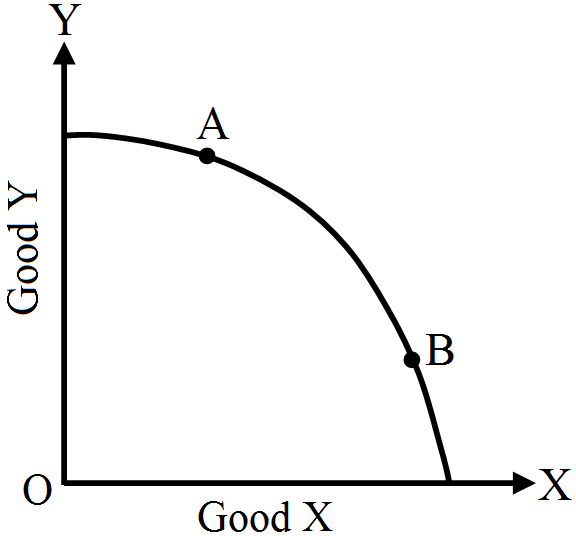
In the given figure, the movement on the production possibility curve from point A to point B shows _______. (Choose the correct alternative).
  1. Growth of all the resources in the economy.
  2. Underutilisation of resources.
  3. Production of more units of good X and less units of good Y.
  4. Production of more units of good Y and less units of good X.
________ refers to a situation where all those who are able to work and are willing to work, are getting work.
  1. Under employment.
  2. Partial employment.
  3. Full employment.
  4. Voluntary employment.
According to law of demand, other things being constant:
  1. There exists negative relationship between quantity demanded and price of a commodity.
  2. With increase in price, there is rightward shift in demand curve.
  3. There exists positive relationship between quantity demanded and price of a commodity.
  4. With increase in price, there is leftward shift in demand curve.
Which of the following is not the property of indifference curve?
  1. Higher the indifference curve higher the level of satisfaction.
  2. Two indifference curves cannot intersect each other.
  3. Indifference curve is concave to origin.
  4. Indifference curve is downward sloping.
What can be the maximum value of investment multiplier?
  1. 5
  2. 0
  3. 4
  4. 2
When there is no change in quantity demand in response to any change in price, it is a situation of:
  1. Zero price elasticity.
  2. Infinite price elasticity.
  3. Unitary price elasticity.
  4. None of these.