MCQ
Consider the following two statements $A$ and $B$ and identify the correct choice in the given answers

$A :$ Line spectra is due to atoms in gaseous state

$B :$ Band spectra is due to molecules

  • A
    Both $A$ and $B$ are false
  • B
    $A$ is true and $B$ is false
  • C
    $A$ is false and $B$ is true
  • Both $A$ and $B$ are true

Answer

Correct option: D.
Both $A$ and $B$ are true
d
(d) Line and band spectrum are also known as atomic and molecular spectra respectively.

Need a full question paper?

Generate a complete, print-ready paper with questions like this in minutes — across 16+ boards, with answer keys.

Start Generating Free

Similar questions

The continuous part of $X$-ray spectrum is a result of the
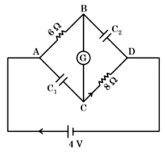
In this figure the resistance of the coil of galvanometer $G$ is $2\,\Omega$. The emf of the cell is $4\,V$. The ratio of potential difference across $C_1$ and $C_2$ is:
An electric kettle has two heating coils. When one of the coils is connected to an a.c. sotuce, the water in the kettle boils in $10$ minutes. When the other coil is used the w’ater boils in $40$ minutes. If both the coils are connected in parallel, the time taken by the same quantity of water to boil will be ...... $min$
If ${\lambda _1}$ and ${\lambda _2}$ are the wavelengths of characteristic $X-$ rays and gamma rays respectively, then the relation between them is
Frequency is the function of density $(\rho )$, length $(a)$ and surface tension $(T)$. Then its value is
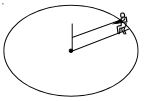
$A$ man is sitting in $a$ smooth groove on a horizontal circular table at the edge by holding a rope joined to the centre. The moment of inertia of table is $I$. Mass of man $= M$. Man now pulls the rope so that he comes to the centre. The angular velocity of the table :
Assertion: Critical angle is minimum for violet colour.

Reason : Because critical angle ${\theta _c} = {\sin ^{ - 1}}\,\left( {\frac{1}{\mu }} \right)$ and $\mu \, \propto \,\frac{1}{\lambda }$.

In $L-C-R$  circuit if resistance increases, quality factor
Three particles of masses $10\;g, 20\;g$ and $40\;g$ are moving with velocities $10\widehat i,10\widehat j$ and  $10\widehat k\;m/s$ respectively. If due to some mutual interaction, the first particle comes to  rest and the velocity of second particle becomes $\left( {3\widehat i + 4\widehat j\,\,} \right)\, m/s$, then the velocity of third particle is
A particle comes round a circle of radius $1 \,m$ once. The time taken by it is $10 \,sec$. The average velocity of motion is