Consider the following two statements.
$(A)$ Kirchhoff's junction law follows from the conservation of charge.
$(B)$ Kirchhoff's loop law follows from the conservation of energy.
Which of the following is correct ?
AIPMT 2010, Easy


Download our appand get started for free
Experience the future of education. Simply download our apps or reach out to us for more information. Let's shape the future of learning together!No signup needed.*
Similar Questions
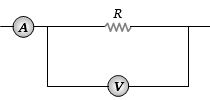
- 1The ammeter $A$ reads $2\, A$ and the voltmeter $V$ reads $20\, V$. the value of resistance $R$ is (Assuming finite resistance's of ammeter and voltmeter)View Solution
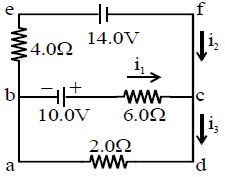
- 2Find the value of current $i_1$ for the circuit shown in figure :- ............ $A$View Solution
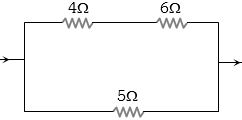
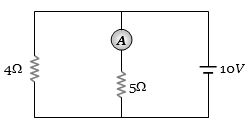
- 3In the circuit shown in figure, the heat produced in $5\, ohm $ resistance is $10\, cal / sec$ . The heat produced in $4$ resistance is ................ $cal /sec$View Solution
- 4View SolutionExpress which of the following setups can be used to verify Ohm’s law
- 5The $H$ amount of thermal energy is developed by a resistor in $10\,s$ when a current of $4\,A$ is passed through it. If the current is increased to $16\,A$, the thermal energy developed by the resistor in $10\,s$ will be $........\,H$View Solution
- 6The $V-i$ graph for a conductor at temperature ${T_1}$ and ${T_2}$ are as shown in the figure. $({T_2} - {T_1})$ is proportional toView Solution
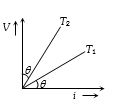
- 7In the circuit, the reading of the ammeter is ................. $A$ (assume internal resistance of the battery be zero)View Solution
- 8View SolutionIf an observer is moving with respect to a stationary electron, then he observes
- 9View SolutionIn charging a battery of motor-car, the following effect of electric current is used
- 10A certain wire has a resistance $R$. The resistance of another wire identical with the first except having twice its diameter isView Solution