Question
Consider the following two statements:
  1. Free-electron density is different in different metals.
  2. Free-electron density in a metal depends on temperature.
Seebeck effect is caused
  1. Due to both A and B.
  2. Due to A but not due to B.
  3. Due to B but not due to A.
  4. Neither due to A nor due to B.

Answer

  1. Due to both A and B.

Explanation:

See back effect is caused due to free electron density is different in different metals or free electron density in a metal depends on temperature.

Need a full question paper?

Generate a complete, print-ready paper with questions like this in minutes — across 16+ boards, with answer keys.

Start Generating Free

Similar questions

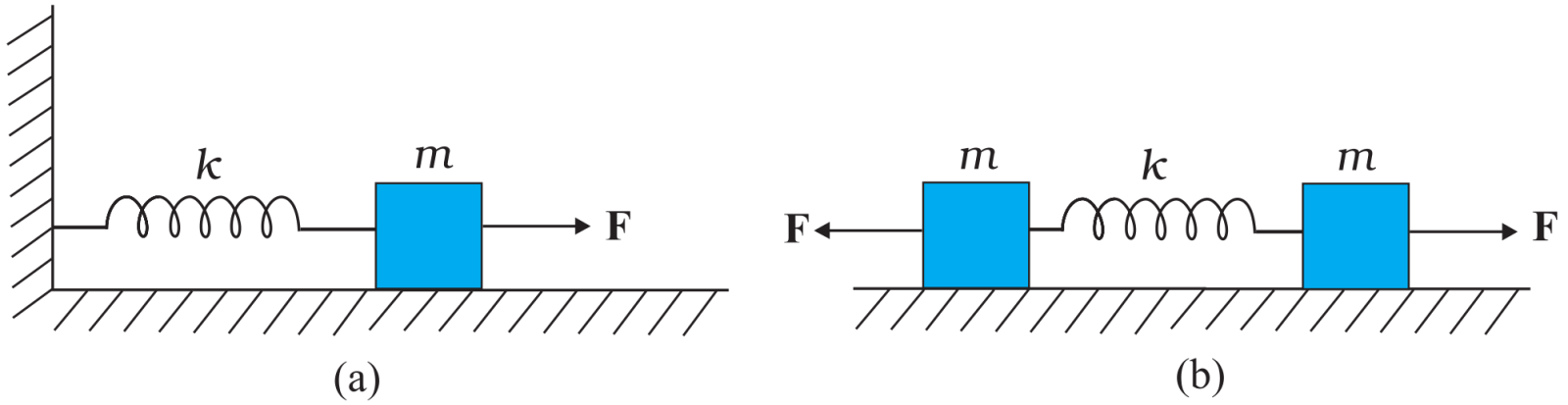
Figure (a) shows a spring of force constant k clamped rigidly at one end and a mass m attached to its free end. A force F applied at the free end stretches the spring. Figure (b) shows the same spring with both ends free and attached to a mass m at either end. Each end of the spring in Fig. (b) is stretched by the same force F.

What is the maximum extension of the spring in the two cases?

Is it possible to liquefy a gas at any condition?
What is the nature of P-V diagram for isobaric and isochoric processes?
The threshold wavelength of a metal is $\lambda_0.$ Light of wavelength slightly less $\tan \lambda_0.$ is incident on an insulated plate made of this metal. It is found that photoelectrons are emitted for some time and after that the emission stops. Explain.
Ifa 1kg weight is hung from a light spring, it makes 4 oscillations in 1 second. If a 4 kg weight is hung from the same spring, how many oscillations will it make per second?
A physical quantity $\text{X}=\frac{\text{a}^2\text{b}^{\frac{-3}{2}}}{\text{c}^4}$ A student says that the relative error in $2\frac{\Delta\text{a}}{\text{a}}-\frac{3}{2}\frac{\Delta\text{b}}{\text{b}}-4\frac{\Delta\text{c}}{\text{c}}.$ Do you agree with the student? If not, what is the relative error in X?
How will the time period of a simple pendulum change when its length is doubled?
What is the order of precision of an atomic clock?
When a launched rocket crosses the limit of Earth's gravitational force, what is the name of the force exerted on it?
The speeds of red light and yellow light are exactly same:
  1. In vacuum but not in air.
  2. In air but not in vacuum.
  3. In vacuum as well as in air.
  4. Neither in vacuum nor in air.