Question
Consider the following very rough model of a beryllium atom. The nucleus has four protons and four neutrons confined to a small volume of radius $10^{-15} m$. The two 1 s electrons make a spherical charge cloud at an average distance of $1.3 \times 10^{-11} m$ from the nucleus, whereas the two 2 s electrons make another spherical cloud at an average distance of $5.2 \times 10^{-11} m$ from the nucleus. Find the electric field at:
  1. A point just inside the 1s cloud.
  2. A point just inside the 2s cloud.

Answer

  1. Let us consider the three surfaces as three concentric spheres A, B and C.
Let us take $q = 1.6 \times 10^{-19}C.$
Sphere A is the nucleus; so, the charge on sphere A, $q_1 = 4q$
Sphere B is the sphere enclosing the nucleus and the 2 1s electrons; so charge on this sphere, $q_2 = 4q - 2q = 2q.$
Sphere C is the sphere enclosing the nucleus and the 4 electrons of Be; so, the charge enclosed by this sphere, $q_3 = 4q - 4q = 0.$
Radius of sphere $A, r_1 = 10^{-15}m$
Radius of sphere $B, r_2 = 1.3 \times 10^{-11}m$
Radius of sphere $C, r_3 = 5.2 \times 10^{-11}m$
As the point 'P' is just inside the spherical cloud 1s, its distance from the centre
$x = 1.3 \times 10^{-11}m$
Electric field,
$\text{E}=\frac{\text{q}}{4\pi\in_0\text{x}^2}$
Here, the charge enclosed is due to the charge of the 4 protons inside the nucleus. So,
$\text{E}=\frac{4\times\big(1.6\times10^{-19}\big)}{4\times3.14\times\big(8.85\times10^{-12}\big)\times\big(1.3\times10^{-11}\big)^2}$
$\text{E}=3.4\times10^{13}\text{N/C}$
  1. For a point just inside the 2s cloud, the total charge enclosed will be due to the 4 protons and 2 electrons. Charge enclosed,
$q_{en}= 2q = 2 \times (1.6 \times 10^{-19})C$
Hence, electric field,
$\text{E}=\frac{\text{q}_{\text{en}}}{4\pi\in_0\text{x}^2}$
$\text{x}=5.2\times10^{-11}\text{m}$
$\text{E}=\frac{2\times\big(1.6\times10^{-19}\big)}{4\times3.14\times\big(8.5\times10^{-12}\big)\times\big(5.2\times10^{-11}\big)^2}$
$\text{E}=1.065\times\text{10}^{12}\text{N/C}$
Thus, $\text{E}=1.1\times\text{10}^{12}\text{N/C}$

Need a full question paper?

Generate a complete, print-ready paper with questions like this in minutes — across 16+ boards, with answer keys.

Start Generating Free

Similar questions

Differentiate between progressive and non- progressive waves.
Find the mass, the kinetic energy and the momentum of an electron moving at O.8c.
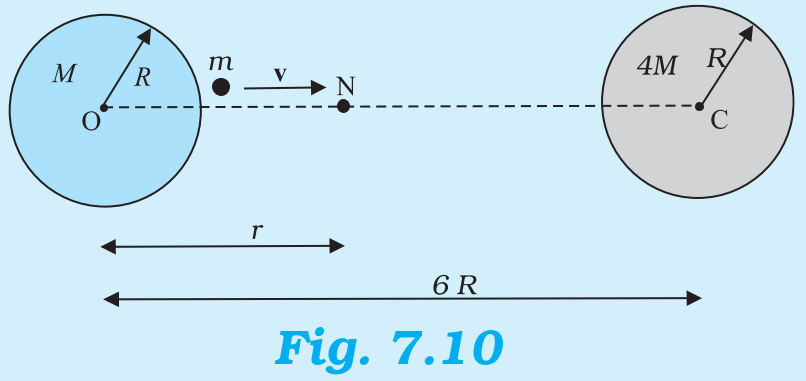
Two uniform solid spheres of equal radii $R$, but mass $M$ and $4 M$ have a centre to centre separation $6 R$, as shown in Fig. $7.10$. The two spheres are held fixed. A projectile of mass $m$ is projected from the surface of the sphere of mass $M$ directly towards the centre of the second sphere. Obtain an expression for the minimum speed $v$ of the projectile so that it reaches the surface of the second sphere.
Image
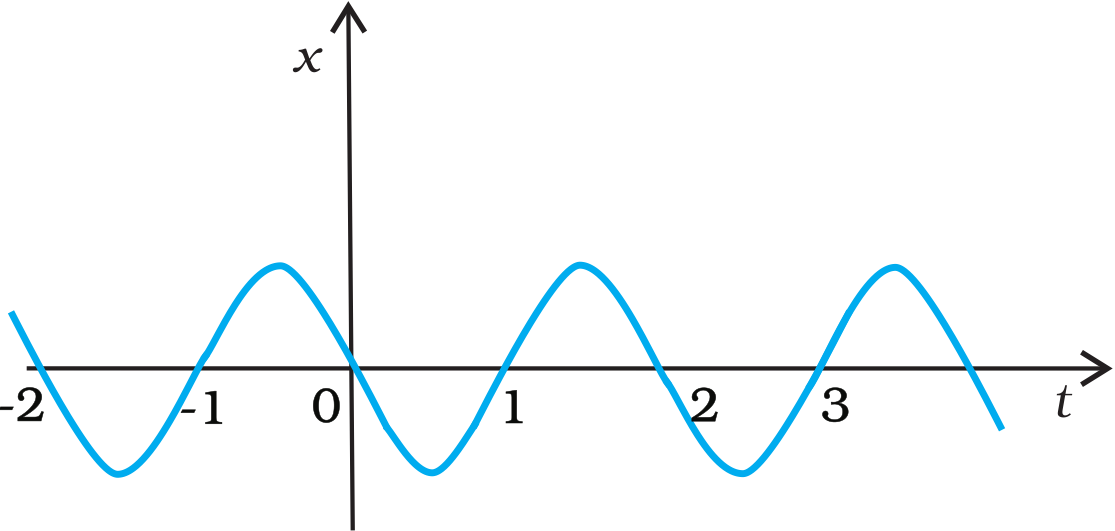
Gives the x-t plot of a particle executing one-dimensional simple harmonic motion. (You will learn about this motion in more detail in Chapter 14). Give the signs of position, velocity and acceleration variables of the particle at t = 0.3 s, 1.2 s, – 1.2 s.
Two objects of masses $m_1$ and $m_2$ are moving with velocities $u_1$ and $u_2$ respectively collide in an inelastic collision. If after the collision both the objects move together then calculate the change in the value of energy
A sound source, fixed at the origin, is continuously emitting sound at a frequency of 660Hz. The sound travels in air at a speed of 330m/s. A listener is moving along the line x = 336m at a constant speed of 26m/s. Find the frequency of the sound as observed by the listener when he is:
  1. At y = - 140m.
  2. At y = 0.
  3. At y = 140m.
Explain by giving definition of Bulk Modulus of elasticity, Modulus of Rigidity and compressibility what are their units and dimensions? What is the relation between co-efficient of elasticity $Y , K$ and $\eta$ ?
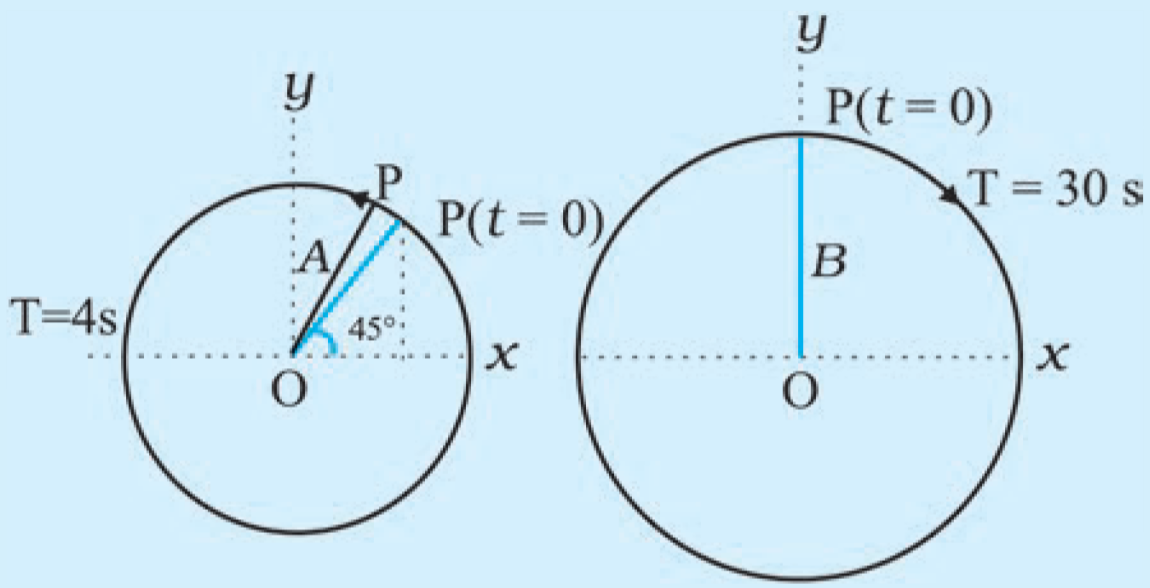
The figure given below depicts two circular motions. The radius of the circle, the period of revolution, the initial position and the sense of revolution are indicated in the figures. Obtain the simple harmonic motions of the x-projection of the radius vector of the rotating particle P in each case.
Image
A scooter company gives the following specifications about its product.
  • Weight of the scooter $-\ 95\ kg$.
  • Maximum speed $-\ 60\ km/h$.
  • Maximum engine power $-\ 3.5hp$.
  • Pick up time to get the maximum speed $-\ 5s$.
  • Check the validity of these specifications.
A long cylindrical wire carries a positive charge of linear density $2.0 \times 10^{-8}Cm^{-1}$. An electron revolves around it in a circular path under the influence of the attractive electrostatic force. Find the kinetic energy of the electron. Note that it is independent of the radius.