MCQ
Consider the function $f :(0, \infty) \rightarrow R$ defined by $f ( x )= e ^{-\left|\log _{ c } x \right|}$. If $m$ and $n$ be respectively the number of points at which $f$ is not continuous and $f$ is not differentiable, then $m + n$ is
  • B
    3
  • C
    1
  • D
    2

Answer

$ f:(0, \infty) \rightarrow R$
$ f(x)=e^{-\left|\log _c\right|}$
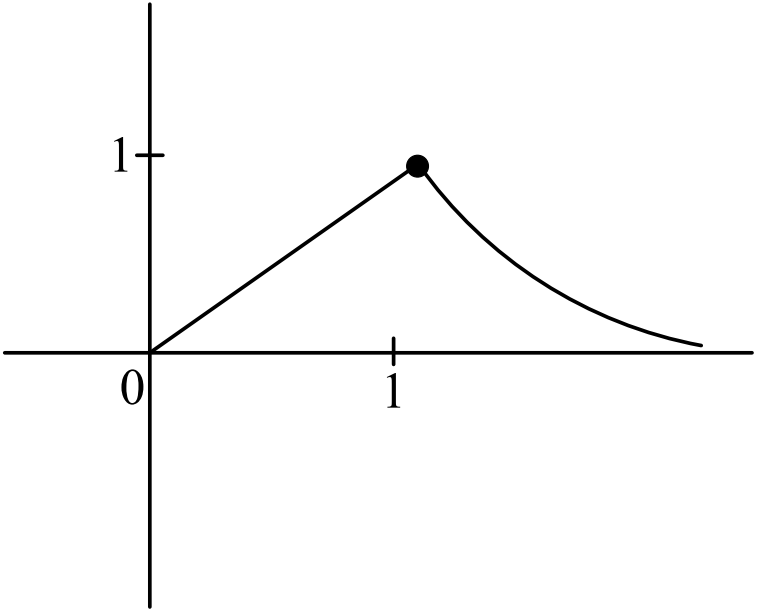
$ f(x)=\frac{1}{e^{\ln x}}=\{\frac{1}{e^{-\ln x}} ; 0\}$
Image
$m = 0 ($No point at which function is not continuous$)$
$n = 1 ($Not differentiable$)$
$\therefore m + n = 1$

Need a full question paper?

Generate a complete, print-ready paper with questions like this in minutes — across 16+ boards, with answer keys.

Start Generating Free

Similar questions

Let $C_{1}$ be the curve obtained by the solution of differential equation $2 xy \frac{ dy }{ dx }= y ^{2}- x ^{2}, x > 0$ Let the curve $C _{2}$ be the solution of $\frac{2 x y}{x^{2}-y^{2}}=\frac{d y}{d x} .$ If both the curves pass through $(1,1),$ then the area enclosed by the curves $C_{1}$ and $C _{2}$ is equal to :
$\int\limits_{ - 1}^0 {\frac{{4{x^2} + 4x + 3}}{{1 + {e^{2x + 1}}}}} dx\, = $
The function $f(x) = 1 - {e^{ - {x^2}/2}}$ is
A committee of $11$ members is to be formed from $8$ males and $5$ females. If $m$ is the number of ways the committee is formed with at least $6$ males and $n$ is the number of ways the committee is formed with at least $3$ females, then
If $l'(x)$ means $\log \log \log .......\log x$, the $\log $ being repeated r times, then $\int_{}^{} {\frac{1}{{xl(x){l^2}(x){l^3}(x)......{l^r}(x)}}\;dx = } $
$\frac{{\cos {{10}^o} + \sin {{10}^o}}}{{\cos {{10}^o} - \sin {{10}^o}}} = $
The centres of those circles which touch the circle ${x^2} + {y^2} - 8x - 8y - 4 = 0$ externally and also touch the $x-$axis, lie on:
The value of $\int_{\sqrt{\ln 2}}^{\sqrt{\ln 3}} \frac{x \sin x^2 {\sin x^2+\sin \left(\ln 6-x^2\right)}} d x$ is
If $\left| {\,\begin{array}{*{20}{c}}{\cos (A + B)}&{ - \sin (A + B)}&{\cos 2B}\\{\sin A}&{\cos A}&{\sin B}\\{ - \cos A}&{\sin A}&{\cos B}\end{array}\,} \right| = 0$, then $B =$
Let $A\, = \,\left( {\begin{array}{*{20}{c}}
0&{2q}&r\\
p&q&{ - r}\\
p&{ - q}&r
\end{array}} \right)$. If $A{A^T}\, = \,{I_3},\,\left| p \right|$ then $\left| p \right|$ is