MCQ
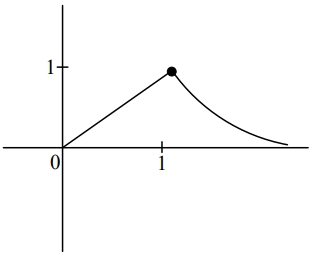
Consider the function $f:(0, \infty) \rightarrow R$ defined by $f(x)=e^{-\left|\log _e x\right|}$. If $m$ and $n$ be respectively the number of points at which $f$ is not continuous and $f$ is not differentiable, then $\mathrm{m}+\mathrm{n}$ is
  • A
    $0$
  • B
    $3$
  • C
    $1$
  • D
    $2$

Answer

$f:(0, \infty) \rightarrow R$
$ f(x)=e^{-\left|\log _e x\right|}$
$\mathrm{f}(\mathrm{x})=\frac{1}{\mathrm{e}^{\ln x \mid}}=\left\{\begin{array}{l}\frac{1}{\mathrm{e}^{-\ln x}} ; 0 < \mathrm{x} < 1 \\ \frac{1}{\mathrm{e}^{\ln x}} ; \mathrm{x} \geq 1\end{array}\right.$
$\left\{\begin{array}{l}\frac{1}{\frac{1}{x}}=x ; 0 < x < 1 \\ \frac{1}{x}, x \geq 1\end{array}\right.$
${m}=0 ($No point at which function is not continuous$)$
${n}=1 ($Not differentiable)
$\therefore \mathrm{m}+\mathrm{n}=1$

Need a full question paper?

Generate a complete, print-ready paper with questions like this in minutes — across 16+ boards, with answer keys.

Start Generating Free

Similar questions

If $\int_0^1 \frac{1}{\sqrt{3+x}+\sqrt{1+x}} d x=a+b \sqrt{2}+c \sqrt{3}$, where $a, b, c$ are rational numbers, then $2 a+3 b-4 c$ is equal to :
The product of the roots of the equation $9 x^{2}-18|x|+5=0,$ is
The equation $ lm\,\left( {\frac{{iz - 2}}{{z - i}}} \right) + 1 = 0\,,z \in C\,,z \ne i$ represents a part of a circle having radius equal to
Let the function $\mathrm{g}:(-\infty, \infty) \rightarrow\left(-\frac{\pi}{2}, \frac{\pi}{2}\right)$ be given by $g(\mathrm{u})=2 \tan ^{-1}\left(e^{\mathrm{u}}\right)-\frac{\pi}{2}$. Then, $\mathrm{g}$ is
Let $A=\left(a_1, a_2\right)$ and $B=\left(b_1, b_2\right)$ be two points in the plane with integer coordinates. Which one of the following is not a possible value of the distance between $A$ and $B$ ?
Equation of angle bisectors between $x$ and $y$ -axes are
Which of the following is(are) $NOT$ the square of a $3 \times 3$ matrix with real entries ?

$[A]$ $\left[\begin{array}{ccc}1 & 0 & 0 \\ 0 & 1 & 0 \\ 0 & 0 & -1\end{array}\right]$

$[B]$ $\left[\begin{array}{ccc}-1 & 0 & 0 \\ 0 & -1 & 0 \\ 0 & 0 & -1\end{array}\right]$

$[C]$ $\left[\begin{array}{lll}1 & 0 & 0 \\ 0 & 1 & 0 \\ 0 & 0 & 1\end{array}\right]$

$[D]$ $\left[\begin{array}{ccc}1 & 0 & 0 \\ 0 & -1 & 0 \\ 0 & 0 & -1\end{array}\right]$

If $\vec a\, = \,\vec i - 2\hat j + 3\hat k,\,\,\,\vec b = 2\vec i + 3\hat j - \hat k$ and $\vec c = \lambda \vec i + \hat j + (2\lambda  - 1\hat k)$ are coplanar vectors, then $\lambda $ is equal to
The solution set of the equation ${\sin ^{ - 1}}x = 2{\tan ^{ - 1}}x$ is
If the middle points of the sides $BC,\, CA$ and $AB$ of the triangle $ABC$ be $(1, 3), \,(5, 7)$ and $(-5, 7)$, then the equation of the side $AB$ is