MCQ
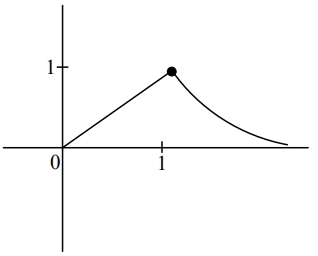
Consider the function $f:(0, \infty) \rightarrow R$ defined by $f(x)=e^{-\left|\log _e x\right|}$. If $m$ and $n$ be respectively the number of points at which $f$ is not continuous and $f$ is not differentiable, then $\mathrm{m}+\mathrm{n}$ is
  • A
    $0$
  • B
    $3$
  • $1$
  • D
    $2$

Answer

Correct option: C.
$1$
c
$f:(0, \infty) \rightarrow R$

$ f(x)=e^{-\left|\log _e x\right|}$

$\mathrm{f}(\mathrm{x})=\frac{1}{\mathrm{e}^{\ln x \mid}}=\left\{\begin{array}{l}\frac{1}{\mathrm{e}^{-\ln x}} ; 0 < \mathrm{x} < 1 \\ \frac{1}{\mathrm{e}^{\ln x}} ; \mathrm{x} \geq 1\end{array}\right.$

$\left\{\begin{array}{l}\frac{1}{\frac{1}{x}}=x ; 0 < x < 1 \\ \frac{1}{x}, x \geq 1\end{array}\right.$

${m}=0$ (No point at which function is not continuous)

{n}=$1$ (Not differentiable)

$\therefore \mathrm{m}+\mathrm{n}=1$

Need a full question paper?

Generate a complete, print-ready paper with questions like this in minutes — across 16+ boards, with answer keys.

Start Generating Free

Similar questions

If $A = [a_{ij}]$ is a square matrix of even order such that $a_{ij} = i^2 - j^2,$ then
The altitude of a cone is $20\ cm$ and its semi $-$ vertical angle is $30^\circ .$ If the semi $-$ vertical angle is increasing at the rate of $2^\circ $ per second, then the radius of the base is increasing at the rate of :
The existence of the unique solution of the system of equations:
$x+y+z=\lambda$
$5 x-y+\mu z=10$
$2 x+3 y-z=6 $ depends on 
$\int_{}^{} {\frac{{{e^{\sqrt x }}\cos {e^{\sqrt x }}}}{{\sqrt x }}dx} = $
Let $A =\{2,3,4,5, \ldots ., 30\}$ and $^{\prime} \simeq ^{\prime}$ be an equivalence relation on $A \times A ,$ defined by $(a, b) \simeq (c, d),$ if and only if $a d=b c .$ Then the number of ordered pairs which satisfy this equivalence relation with ordered pair $(4,3)$ is equal to :
$f(x)=x^x$ has a stationary point at
If $A = \left[ {\begin{array}{*{20}{c}}\alpha &0\\1&1\end{array}} \right]$ and $B = \left[ {\begin{array}{*{20}{c}}1&0\\5&1\end{array}} \right]$, then value of $\alpha $for which ${A^2} = B$, is
If the function $f(x) = 2x^2 - kx + 5$ is increasing on $[1, 2]$, then $k$ lies in the interval :
Solution of the following $LP$ problem

Maximize $z=2 x+6 y$ subject to $-x+y \leq 1,2 x+y \leq 2$ and $x \geq 0, y \geq 0 "$ is $.......$

If $S$ is the sum of the first $10$ terms of the series $\tan ^{-1}\left(\frac{1}{3}\right)+\tan ^{-1}\left(\frac{1}{7}\right)+\tan ^{-1}\left(\frac{1}{13}\right)+\tan ^{-1}\left(\frac{1}{21}\right)+\ldots$ then $\tan ( S )$ is equal to