MCQ
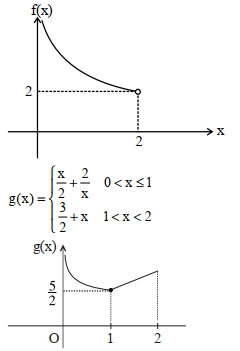
Consider the function $\mathrm{f}:(0,2) \rightarrow \mathrm{R}$ defined by $f(x)=\frac{x}{2}+\frac{2}{x}$ and the function$ g(x)$ defined by $g(x)=\left\{\begin{array}{cc}\min \{f(t)\}, & 0 < t \leq x \text { and } 0 < x \leq 1 \\ \frac{3}{2}+x, & 1 < x< 2\end{array}\right.$. Then
  •  $g$ is continuous but not differentiable at $x=1$
  • B
    $\mathrm{g}$ is not continuous for all $\mathrm{x} \in(0,2)$
  • C
     $g$ is neither continuous nor differentiable at $x=1$
  • D
     $g$ is contimuous and differentiable for all $\mathrm{x} \in(0,2)$
Answer

Correct option: A.
 $g$ is continuous but not differentiable at $x=1$
a
$ f:(0,2) \rightarrow R ; f(x)=\frac{x}{2}+\frac{2}{x} $

$ f^{\prime}(x)=\frac{1}{2}-\frac{2}{x^2}$

$\therefore \mathrm{f}(\mathrm{x})$ is decreasing in domain.

Need a full question paper?

Generate a complete, print-ready paper with questions like this in minutes — across 16+ boards, with answer keys.

Start Generating Free

Similar questions

If $a, b, c$ be positive real numbers and the value of $\theta = {\tan ^{ - 1}}\sqrt {\frac{{a(a + b + c)}}{{bc}}} + {\tan ^{ - 1}}\sqrt {\frac{{b(a + b + c)}}{{ca}}} + {\tan ^{ - 1}}\sqrt {\frac{{c(a + b + c)}}{{ab}}} $,then $\tan \theta $ is equal to
Mean and variance of a binomial probability distribution are $4$ and $\frac{4}{3}$ respectively then the probability of atleast two success is equal to
The number ${\log _{20}}3$  lies in
The solution of the differential equation $\cos y\log (\sec x + \tan x)dx = \cos x\log (\sec y + \tan y)dy$ is
Let $f(x)$ be a non-constant polynomial with real coefficients such that $f\left(\frac{1}{2}\right)=100$ and $f(x) \leq 100$ for all real $x$. Which of the following statements is NOT necessarily true?
Consider the following system of equations : $x+2 y-3 z=a$ ; $2 x+6 y-11 z=b$ ; $x-2 y+7 z=c$    where $a , b$ and $c$ are real constants. Then the system of equations :
Let $a_{1}, a_{2}, a_{3}, \ldots$ be an $A.P.$ If $\sum_{r=1}^{\infty} \frac{a_{r}}{2^{r}}=4$, then $4 a_{2}$ is equal to
If $f(x) = \left\{ \begin{array}{l}x + 2\,, - 1 < x < 3\\5\,\,\,\,\,\,\,\,,\,\,\,\,x = 3\\8 - x\,,\,\,\,\,x > 3\end{array} \right.$, then at $x = 3$, $f'(x) = $
Let a circle $C_1$ be obtained on rolling the circle $x^2+y^2-4 x-6 y+11=0$ upwards 4 units on the tangent $T$ to it at the point $(3,2)$. Let $C _2$ be the image of $C _1$ in T. Let A and B be the centers of circles $C _1$ and $C _2$ respectively, and $M$ and $N$ be respectively the feet of perpendiculars drawn from $A$ and $B$ on the $x$-axis. Then the area of the trapezium $AMNB$ is :
The equation of the circle concentric with the circle ${x^2} + {y^2} - 4x - 6y - 3 = 0$ and touching $y$-axis, is