MCQ
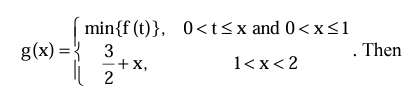
Consider the function $f:(0,2) \rightarrow R$ defined by $f(x)=\frac{x}{2}+\frac{2}{x}$ and the function $g(x)$ defined by
Image
  • A
    g is continuous but not differentiable at x = 1
  • B
    g is not continuous for all $x \in(0,2)$
  • C
    g is neither continuous nor differentiable at x = 1
  • D
    g is continuous and differentiable for all $x \in(0,2)$
Answer

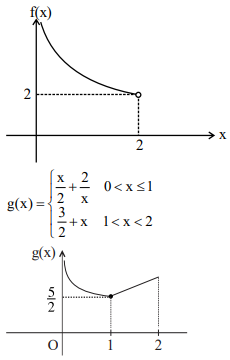
$f:(0,2) \rightarrow R ; f(x)=\frac{x}{2}+\frac{2}{x}$
$f^{\prime}(x)=\frac{1}{2}-\frac{2}{x^2}$
$\therefore f ( x )$ is decreasing in domain.
Image

Need a full question paper?

Generate a complete, print-ready paper with questions like this in minutes — across 16+ boards, with answer keys.

Start Generating Free

Similar questions

If $a,b,c$ and$u,v,w$ are complex numbers representing the vertices of two triangles such that $c = (1 - r)a + rb$ and $w = (1 - r)u + rv$, where $r$ is a complex number, then the two triangles
The maximum volume (in $cu.m$) of the right circular cone having slant height $3\, m$ is
If $\cos \theta - \sin \theta = \sqrt 2 \sin \theta ,$ then $\cos \theta + \sin \theta $ is equal to
Two dice are thrown. What is the probability that the sum of the numbers appearing on the two dice is $11$, if $5$ appears on the first
Let $\vec{\alpha}=4 \hat{ i }+3 \hat{ j }+5 \hat{ k }$ and $\vec{\beta}=\hat{ i }+2 \hat{ j }-4 \hat{ k }$. Let $\vec{\beta}_1$ be parallel to $\vec{\alpha}$ and $\vec{\beta}_2$ be perpendicular to $\vec{\alpha}$. If $\vec{\beta}=\vec{\beta}_1+\vec{\beta}_2$, then the value of $5 \vec{\beta}_2 \cdot(\hat{ i }+\hat{ j }+\hat{ k })$ is
The equation $\sqrt {3 {x^2} + x + 5} = x - 3$ , where $x$ is real, has
If the system of equations

$2 x+y-z=5$

$2 x-5 y+\lambda z=\mu$

$x+2 y-5 z=7$

has infinitely many solutions, then $(\lambda+\mu)^2+(\lambda-\mu)^2$ is equal to

The minors of $ -4$ and  $ 9$  and the co-factors of  $-4$  and $ 9$ in determinant $\,\left| {\,\begin{array}{*{20}{c}}{ - 1}&{ - 2}&3\\{ - 4}&{ - 5}&{ - 6}\\{ - 7}&8&9\end{array}\,} \right|$ are respectively
The minimum distance between a point on the curve $y=e^x$ and a point on the curve $y=\log _e x$ is
The locus of the point of intersection of the lines, $\sqrt 2 x - y + 4\sqrt 2 k = 0$ and $\sqrt 2 kx + ky - 4\sqrt 2  = 0$ ( $k$ is any non-zero real parameter) is