MCQ
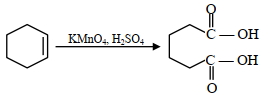
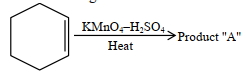
Consider the given chemical reaction :

Product "$A$" is :
  • A
    picric acid
  • B
    oxalic acid
  • C
    acetic acid
  • adipic acid

Answer

Correct option: D.
adipic acid
d

Need a full question paper?

Generate a complete, print-ready paper with questions like this in minutes — across 16+ boards, with answer keys.

Start Generating Free

Similar questions

Which of the following species would not be involved in the Hoffmann  rearrangement shown below ?
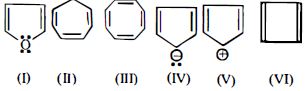
Which of the following compounds are antiaromatic
$50 \mathrm{~mL}$ of $0.2$ molal urea solution (density $=1.012 \mathrm{~g} \mathrm{~mL}^{-1}$ at $300 \mathrm{~K}$ ) is mixed with $250 \mathrm{~mL}$ of a solution containing $0.06 \mathrm{~g}$ of urea. Both the solutions were prepared in the same solvent. The osmotic pressure (in Torr) of the resulting solution at $300 \mathrm{~K}$ is . . . . .$\left.\Delta_{\operatorname{mix}} \mathrm{V}=0\right]$
Which of the following are correct order of stability of oxidation states of cations

$(a)\ Pb^{+2} > Pb^{+4} , Tl^{+1} < Tl^{+3}$

$(b)\ Bi^{+3} < Sb^{+3 }, Sn^{+2} < Sn^{+4}$

$(c)\ Pb^{+2} > Pb^{+4} , Bi^{+3} > Bi^{+5}$

$(d)\ Tl^{+3} < In^{+3} , Sn^{+2} > Sn^{+4}$

$(e)\ Sn^{+24} < Pb^{+2} , Sn^{+4} > Pb^{+4}$

$(f)\ Sn^{+2} < Pb^{+2} , Sn^{+4} < Pb^{+4}$

A nitrogen containing organic compound on heating with chloroform and alcoholic $KOH$, evolved very unpleasant smelling vapour. The compound could be
Determine the order of reaction on the basis of following data for the reaction $A + B \to C$
Exp. $[A]$ $[B]$ Rate of reaction
$1$ $0.1$ $0.1$ $2 \times {10^{ - 3}}\,mol\,{L^{ - 1}}\,{\sec ^{ - 1}}$
$2$ $0.4$ $0.1$ $0.4 \times {10^{ - 2}}\,mol\,{L^{ - 1}}\,{\sec ^{ - 1}}$
$3$ $0.1$ $0.2$ $1.4 \times {10^{ - 2}}\,mol\,{L^{ - 1}}\,{\sec ^{ - 1}}$
The correct order of increasing bond length of $C - H, C - O, C - C$ and $C=C$ is
$\xrightarrow[{B{r_2}}]{{O\mathop H\limits^ \ominus  }} \, ;$ Intermediate of the given reaction is/are
In the main group elements $(i)$ as we proceed down the same group in the periodic table and $(ii)$ as we proceed from left to right in the same period, the atomic radius
Which one of the halogen acids is a liquid