MCQ
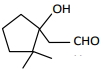
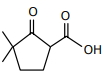
Consider the given reaction, the product $'X^{\prime}$ is:
  • A

  • B

  • C


Answer

Correct option: D.

d
Aldol reaction and than iodo form reaction.

Need a full question paper?

Generate a complete, print-ready paper with questions like this in minutes — across 16+ boards, with answer keys.

Start Generating Free

Similar questions

The equlilibrium constant for the following general reaction is $10^{30}$. Calculate $E^o$ for the cell at $298\, K$. .............. $\mathrm{V}$

$2{X_2}\left( s \right) + 3{Y^{ + 2}}\left( {aq} \right) \to 2X_2^{3 + }\left( {aq} \right) + 3Y\left( s \right)$

Which will give same osazone when treated with phenyl hydrazine ?

$(A)$ Glucose  $(B)$ Gulose
$(C)$ Fructose  $(D)$ Maltose
$(E)$ Mannose

Arrange the following in increasing order of solubility product :
$\mathrm{Ca}(\mathrm{OH})_{2}, \mathrm{AgBr}, \mathrm{PbS}, \mathrm{HgS}$
The letter ‘$D$’ in carbohydrates represents
If there is $2$ nodal surfaces in third excited state. Find the orbital angular momentum
Given below are two statements: one is labelled as Assertion $A$ and the other is labelled as Reason $R$

Assertion $A:$ In equation $\Delta_r G =- nFE _{\text {cell }}$ value of $\Delta_r G$ depends on $n$.

Reasons $R$ : $E_{\text {cell }}$ is an intensive property and $\Delta_{ r } G$ is an extensive property.

In the light of the above statements, choose the correct answer from the options given below

Which of these reagents would accomplish the following reduction ?

$\begin{matrix}
   O\,\,\,\,\,\,\,\,\,\,\,\,\,\,\,\, \,\, \\
   ||\,\,\,\,\,\,\,\,\,\,\,\,\,\,\,\,\,\,  \\
   N\equiv C-C{{H}_{2}}-C-C{{H}_{2}}-CH=C{{H}_{2}}\to   \\
\end{matrix}$ $\begin{matrix}
   OH\,\,\,\,\,\,\,\,\,  \\
   |\,\,\,\,\,\,\,\,\, \,\,\,\, \\
   N\equiv C-C{{H}_{2}}-\underset{H}{\mathop{C}}\,-C{{H}_{2}}-CH=C{{H}_{2}}  \\
\end{matrix}$
According to Bohr's model of hydrogen atom, which of the following statement is incorrect?
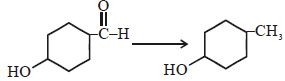
Which of the following can be used in above reaction as a reagent ?
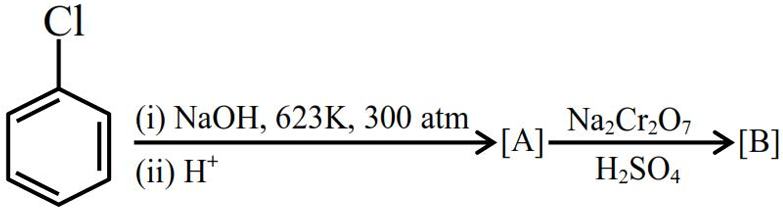
Identify the products $[A]$ and $[B]$, respectively in the following reaction :
Image