MCQ
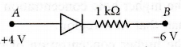
Consider the junction diode as ideal. The value of current flowing through $AB$ is
  • $10^{-2}\;A$
  • B
    $10^{-1}\;A$
  • C
    $10^{-3}\;A$
  • D
    $0\;A$

Answer

Correct option: A.
$10^{-2}\;A$
a
Here, the $p-n$ junction diode is forwarc biased, hence it offers zero resistance

$\therefore {{I}_{AB}}=\frac{{{V}_{A}}-{{V}_{B}}}{{{R}_{AB}}}=$ $\frac{4\text{V}-(-6\text{V})}{1\text{k}\Omega }=$ $\frac{10}{1000}\text{A}={{10}^{-2}}\text{A}$

Need a full question paper?

Generate a complete, print-ready paper with questions like this in minutes — across 16+ boards, with answer keys.
Start Generating Free

Similar questions

If an astronomical telescope has objective and eye-pieces of focal length $200 \;cm$ and $4 \;cm$ respectively, then the magnifying power of the telescope for the normal vision is
The electron concentration in an $n-$type semiconductor is the same as hole concentration in a $p-$type semiconductor. An external field (electric) is applied across each of them. Compare the currents in them.
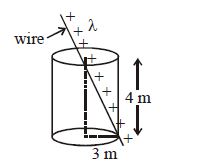
Linear charge density of wire is $8.85\,\mu C/m$ . Radius and height of the cylinder are $3\,m$ and $4\,m$ . Then find the flux passing through the cylinder
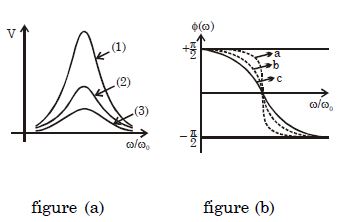
Figure $(a)$  shows plot of voltage across the capacitor as a function of the driving frequency for a sinusoidally driven electromagnetic oscillator $LCR$ circuit. Figure $(b)$ shows phase angle $\phi$ (phase difference between voltage and current) vs $\omega/\omega_0$ graph for same circuit, for three different quality factor graph $1, 2, 3$ of figure $(a)$ and each one can be  matched by one of graphs $a, b, c$ also of figure $(b)$ :-
The energy spectrum of $\beta$-particles [number $N(E)$ as a function of $\beta$-energy $E$] emitted from a radioactive source is
What fraction of a radioactive material will get disintegrated in a period of two half-lives
Neutron decay in free space is given as follows

$_0{n^1}\, \to {\,_1}{H^1}\, + {\,_{ - 1}}{e^0}\, + \,[\,\,]$

Then the particle in the bracket is

Magnetic dipole moment of a rectangular loop is
For the same speed, de Broglie wavelength.
The difference between the sum of the masses of the constituent particles and the mass of an atom is called $......$.