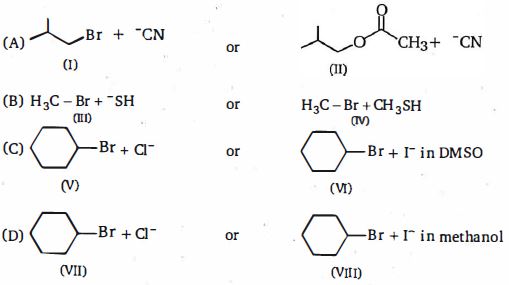
- A$(A-I);(B-IV);(C-VI);(D-VIII)$
- B$(A-II);(B-III);(C-V);(D-VIII)$
- ✓$(A-I);(B-III);(C-V);(D-VIII)$
- D$(A-I);(B-III);(C-V);(D-VII)$
$(B)$ $SH^{\ominus}$ is best $Nu^{\ominus}$ than $MeSH$
$(C)$ $Cl^{\ominus}$ is best $Nu^{\ominus}$ than $I^{\ominus}$ in $DMSO$
$(D)$ In polar protic solvent $I^{\ominus}$ is better $Nu^{\ominus}$ than $Cl^{\ominus}$
Generate a complete, print-ready paper with questions like this in minutes — across 16+ boards, with answer keys.

Statement $I$: $\mathrm{PF}_5$ and $\mathrm{BrF}_5$ both exhibit $\mathrm{sp}^3 \mathrm{~d}$ hybridisation.
Statement $II$: Both $\mathrm{SF}_6$ and $\left[\mathrm{Co}\left(\mathrm{NH}_3\right)_6\right]^{3+}$ exhibit $\mathrm{sp}^3 \mathrm{~d}^2$ hybridisation.
In the light of the above statements, choose the correct answer from the options given below:
$Pt|H_2(P_1\ atm)\ | \ H^+(x_1M)\ ||\ H^+(x_2M)\ |\ H_2(P_2\ atm)\ |Pt$ .
The cell reaction will be spontaneous if