MCQ
Consider the piecewise defined functionf $f(x) = \left[ \begin{gathered}   \hfill \\   \hfill \\   \hfill \\   \hfill \\ \end{gathered}  \right.$$\begin{gathered}  \sqrt { - x}  & if\,\,\,\,\,\,\,\,\,\,x < 0 \hfill \\    \hfill \\  \,\,\,\,\,\,0 & if\,\,0 \leqslant x \leqslant 4 \hfill \\   \hfill \\  x - 4 & if\,\,\,\,\,\,\,\,\,\,x > 4 \hfill \\  \end{gathered} $ choose the answer which best describes the continuity of this function
  • A
    The function is unbounded and therefore cannot be continuous.
  • B
    The function is right continuous at $x = 0$
  • C
    The function has a removable discontinuity at $0$ and $4$, but is continuous on the rest of the real line.
  • The function is continuous on the entire real line
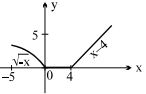
Answer

Correct option: D.
The function is continuous on the entire real line
d
Refer to the graph 

Need a full question paper?

Generate a complete, print-ready paper with questions like this in minutes — across 16+ boards, with answer keys.

Start Generating Free

Similar questions

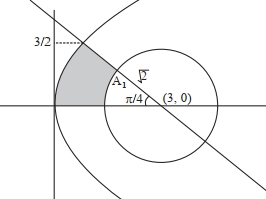
If the area bounded by the curve $2 y^2=3 x$, lines $x+y=3, y=0$ and outside the circle $(x-3)^2+y^2=2$ is $A$, then $4(\pi+4 A )$ is equal to $.........$.
The value of $\sum\limits_{n = 1}^N {{U_n},} $ if ${U_n} = \left| {\,\begin{array}{*{20}{c}}n&1&5\\{{n^2}}&{2N + 1}&{2N + 1}\\{{n^3}}&{3{N^2}}&{3N}\end{array}\,} \right|$ is
Let $\vec{a}, \vec{b}, \vec{c}$ be three vectors mutually perpendicular to each other and have same magnitude. If a vector $\overrightarrow{\mathrm{r}}$ satisfies.

$\overrightarrow{\mathrm{a}} \times\{(\overrightarrow{\mathrm{r}}-\overrightarrow{\mathrm{b}}) \times \overrightarrow{\mathrm{a}}\}+\overrightarrow{\mathrm{b}} \times\{(\overrightarrow{\mathrm{r}}-\overrightarrow{\mathrm{c}}) \times \overrightarrow{\mathrm{b}}\}+\overrightarrow{\mathrm{c}} \times\{(\overrightarrow{\mathrm{r}}-\overrightarrow{\mathrm{a}}) \times \overrightarrow{\mathrm{c}}\}=\overrightarrow{0}$

then $\overrightarrow{\mathrm{r}}$ is equal to:

Solve $xdx\, + ydy\, = \,\frac{{xdy\, - \,ydx}}{{{x^2}\, + \,{y^2}}}$
The value of definite integral $\int\limits_0^{\frac{1}{2}} {\frac{{\ln \left( {1 + 2x} \right)}}{{1 + 4{x^2}}}} \,dx$ , equals
If the volume of parallelepiped formed by the vectors $\hat i + \lambda \hat j + \hat k$, $\hat j + \lambda \hat k$ and $\lambda \hat i + \hat k$ is minimum, then $\lambda $ is equal to
The area between the parabolas ${x^2} = \frac{y}{4}$ and ${x^2} = 9y$ and the striaght line $y=2 $ is :
Let $F(\alpha ) = \left[ {\begin{array}{*{20}{c}}{\cos \alpha }&{ - \sin \alpha }&0\\{\sin \alpha }&{\cos \alpha }&0\\0&0&1\end{array}} \right]$, where $\alpha \in R.$ Then ${[F(\alpha )]^{ - 1}}$ is equal to
If A and B are two events such that $\text{P(A)}=\frac{1}{2},\text{P(B)}=\frac{1}{3},\text{P}(\text{A}|\text{B})=\frac{1}{4},$ then $\text{P}(\overline{\text{A}}\cap\overline{\text{B}})$ equals.
$\int\limits^{\infty}_0\log\Big(\text{x}+\frac{1}{\text{x}}\Big)\frac{1}{1+\text{x}^2}\text{ dx}=$