Question
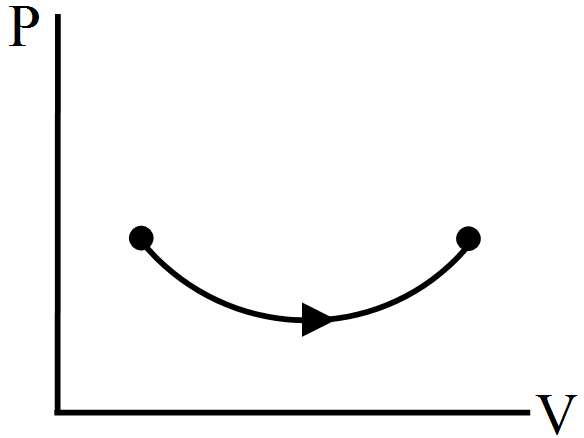
Consider the process on a system shown in figure. During the process, the work done by the system:
  1. Continuously increases.
  2. Continuously decreases.
  3. First increases then decreases.
  4. First decreases then increases.

Answer

  1. Continuously increases.

Explanation:

Work done by a system, $\text{W}=\int\text{PdV}$

Here,

P = Pressure on the system

dV = change in volume

Since dV is positive, i.e. the volume is continuously increasing, work done by the system also continuously increases.

Need a full question paper?

Generate a complete, print-ready paper with questions like this in minutes — across 16+ boards, with answer keys.

Start Generating Free

Similar questions

The centre of mass of a system particles does not depend on:
You are on a frictionless horizontal plane. How can you get off if no horizontal force is exerted by pushing against the surface
Three rods each of length $L$ and mass $M$ are placed along $X$, $Y$ and $Z$ - axes in such a way that one end of each of the rod is at the origin. The moment of inertia of this system about $Z$ axis is
A body is dropped from a certain height $h$ ( $h$ is very large) and second body is thrown downward with velocity of $5 \,m / s$ simultaneouly. What will be difference in heights of the two bodies after $3 \,s$ is ....... $m$
A rigid ball rolls without slipping on a surface shown below: Which one of the following is the most likely representation of the distance travelled by the ball versus time graph?
A butterfly is flying with a velocity $4 \sqrt{2} \,{m} / {s}$ in North-East direction. Wind is slowly blowing at $1$ ${m} / {s}$ from North to South. The resultant displacement of the butterfly in $3\, seconds$ is $....\,{m}.$
A spherical black body with a radius of $24\;cm$ radiates $440\;W$ power at $500\;K$. If the radius were halved and the temperature doubled, the power radiated in watt would be
A particle of mass $m$ is attached to three identical springs $A, B$ and $C$ each of force constant $ k$ a shown in figure. If the particle of mass $m$ is pushed slightly against the spring $A$ and released then the time period of oscillations is
Two point masses of mass $4m$ and $m$ respectively separated by $d$ distance are revolving under mutual force of attraction. Ratio of their kinetic energies will be :
A copper ball of radius $'r'$ travels with a uniform speed $'v'$ in a viscous fluid. If the ball is changed with another ball of radius $'2r'$ , then new uniform speed will be