Question
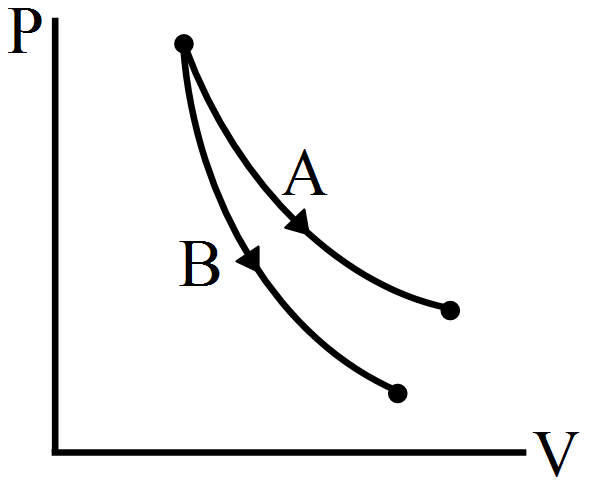
Consider the processes A and B shown in the figure. It is possible that:
  1. Both the processes are isothermal.
  2. Both the processes are adiabatic.
  3. A is isothermal and B is adiabatic.
  4. A is adiabatic and B is isothermal.

Answer

  1. A is isothermal and B is adiabatic.
Explanation:
The slope of an adiabatic process is greater than that of an isothermal process. Since A and B are initiated from the same initial state, both cannot be isothermal or adiabatic, as they would be overlapping. But the curve of process B is steeper than the curve of process A. Hence, A is isothermal and B is adiabatic.

Need a full question paper?

Generate a complete, print-ready paper with questions like this in minutes — across 16+ boards, with answer keys.

Start Generating Free

Similar questions

A long straight wire carries a current of $\pi\ \text{amp.}$ The magnetic field due to it will be $5 \times 10^{-5}\ \ce{Weber/m^2}$  at what distance from the wire $[\mu_0=$ permeability of air$]$
The angle of minimum deviation for a prism is 40° and the angle of the prism is 60°. The angle of incidence in this position will be(a) 30°  (b) 60°(c) 50° (d) 100°
       
Polarising angle for water is 53°4'. If light is incident at this angle on the surface of water and reflected, the angle of refraction is (a) 53°4'  (b) 126°56'(c) 36°56'(d) 30°4'
       
Two sources are called coherent if they produce waves:
  1. Of equal wavelength.
  2. Of equal velocity.
  3. Having same shape of wavefront.
  4. Having a constant phase difference.
The collector plate in an experiment on photoelectric effect is kept vertically above the emitter plate. Light source is put on and a saturation photocurrent is recorded. An electric field is switched on which has a vertically downward direction.
According to Mosley's law, the frequency of a spectral line in X-ray spectrum varies as(a) Atomic number of the element(b) Square of the atomic number of the element(c) Square root of the atomic number of the element(d) Fourth power of the atomic number of the element


Consider the following two statements $A$ and $B$ and identify the correct choice given in the answers
$(A)$ Duddells thermo$-$galvanometer is suitable to measure direct current only
$(B)$ Thermopile can measure temperature differences of the order of $10^{-3}{ }^{\circ} \mathrm{C}$
Three long, straight and parallel wires carrying currents are arranged as shown in the figure. The wire $C$ which carries a current of $5.0 \ \text{amp}$ is so placed that it experiences no force. The distance of wire $C$ from wire $D$ is then
A current of $1\ mA$ is flowing through a copper wire.  How many electrons will pass a given point in one second $[e = 1.6 \times 10^{–19}$ Coulomb$]$
A straight conductor carries a current. Assume that all free electrons in the conductor move with the same drift velocity v. A and B are two observers on a straight line XY parallel to the conductor. A is stationary. B moves along XY with a velocity v in the direction of the free electrons.