Question
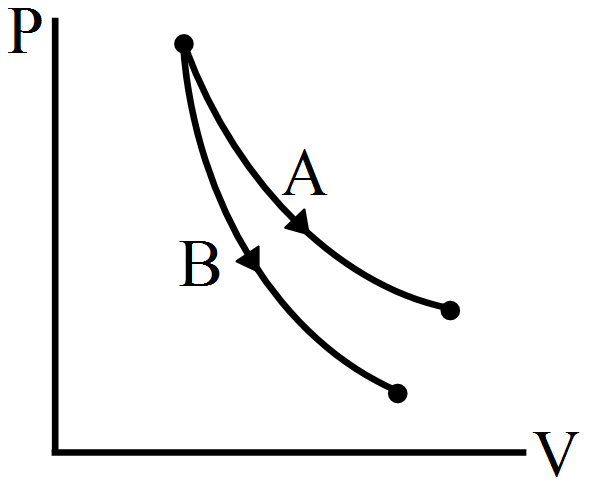
Consider the processes A and B shown in the figure. It is possible that:
  1. Both the processes are isothermal.
  2. Both the processes are adiabatic.
  3. A is isothermal and B is adiabatic.
  4. A is adiabatic and B is isothermal.

Answer

  1. A is isothermal and B is adiabatic.

Explanation:

The slope of an adiabatic process is greater than that of an isothermal process. Since A and B are initiated from the same initial state, both cannot be isothermal or adiabatic, as they would be overlapping. But the curve of process B is steeper than the curve of process A. Hence, A is isothermal and B is adiabatic.

Need a full question paper?

Generate a complete, print-ready paper with questions like this in minutes — across 16+ boards, with answer keys.

Start Generating Free

Similar questions

$Assertion :$ Stress is the internal force per unitarea of a body.
$Reason :$ Rubber is more elastic than steel.
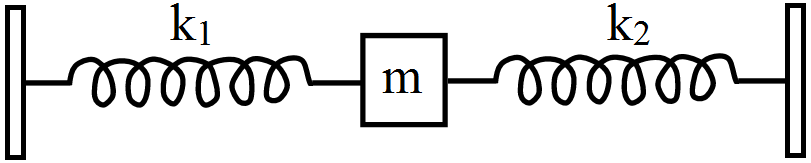
Two spring of force constants k1 and k2 are connected to a mass m as shown in figure. The frequency of oscillation of the mass is f. If both k1 and k2 are made four times their original values, the frequency of oscillation becomes

A bomb of mass $9\, kg$ explodes into two pieces of masses $3\, kg$ and $6\, kg$. The velocity of mass $3\, kg$ is $16\, m/s$. The $KE$ of mass $6\, kg$ is ............ $\mathrm{J}$
A system is provided with 200 cal of heat and the work done by the system on the surroundings is 40J. Then, its internal energy:
The decrease in the potential energy of a ball of mass $20 \,kg$ which falls from a height of $50 \,cm$ is ............ $\mathrm{J}$
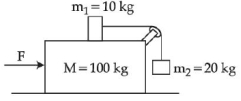
Three masses $M =100\,kg , m _{1}=10\,kg$ and $m_{2}=20\,kg$ are arranged in a system as shown in figure. All the surfaces are frictionless and strings are inextensible and weightless. The pulleys are also weightless and frictionless. $A$ force $F$ is applied on the system so that the mass $m_{2}$ moves upward with an acceleration of $2\,ms ^{-2}$. The value of $F$ is $......N$

$\left(\right.$ Take $\left.g =10\,ms ^{-2}\right)$

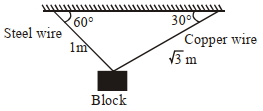
A block of weight $100 N$ is suspended by copper and steel wires of same cross sectional area $0.5 cm ^2$ and, length $\sqrt{3} m$ and $1 m$, respectively. Their other ends are fixed on a ceiling as shown in figure. The angles subtended by copper and steel wires with ceiling are $30^{\circ}$ and $60^{\circ}$, respectively. If elongation in copper wire is $\left(\Delta \ell_{ C }\right)$ and elongation in steel wire is $\left(\Delta \ell_{ s }\right)$, then the ratio $\frac{\Delta \ell_{ C }}{\Delta \ell_{ S }}$ is. . . . . .

[Young's modulus for copper and steel are $1 \times 10^{11} N / m ^2$ and $2 \times 10^{11} N / m ^2$ respectively]

The area below the given curve between emission capacity $E _\lambda$ of a black-body and $\lambda$. is proportional to :
$105$ calories of heat is required to raise the temperature of $3$ moles of an ideal gas at constant pressure from $30^{\circ} C$ to $35^{\circ} C$. The amount of heat required in calories to raise the temperature of the gas through the range $\left(60^{\circ} C\right.$ to $\left.65^{\circ} C \right)$ at constant volume is ........ $cal$ $\left(\gamma=\frac{C_p}{C_v}=1.4\right)$
Four particles, each of mass $M$ and equidistant from each other, move along a circle of radius $R$ under the action of their mutual gravitational attraction. The speed of each particle is