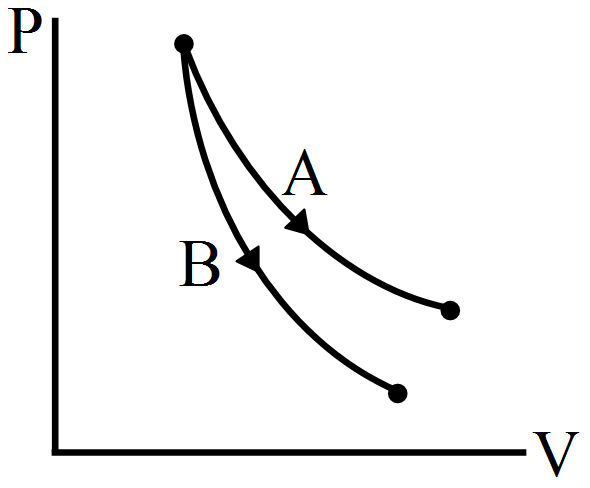
- Both the processes are isothermal.
- Both the processes are adiabatic.
- A is isothermal and B is adiabatic.
- A is adiabatic and B is isothermal.

Explanation:
The slope of an adiabatic process is greater than that of an isothermal process. Since A and B are initiated from the same initial state, both cannot be isothermal or adiabatic, as they would be overlapping. But the curve of process B is steeper than the curve of process A. Hence, A is isothermal and B is adiabatic.
Generate a complete, print-ready paper with questions like this in minutes — across 16+ boards, with answer keys.
The nature of binding for a crystal with alternate and evenly spaced positive and negative ions is
|
(a) Covalent |
(b) Metallic |
(c) Dipolar |
(d) Ionic |
The fact that the conductance of some metals rises to infinity at some temperature below a few Kelvin is called
|
(a) Thermal conductivity |
(b) Optical conductivity |
|
(c) Magnetic conductivity |
(d) Superconductivity |
A certain wire has a resistance R. The resistance of another wire identical with the first except having twice its diameter is
|
(a) 2R |
(b) 0.25 R |
(c) 4R |
(d) 0.5 R |
"Lux" is a unit of
|
(a) Luminous intensity of a source |
(b) Illuminance on a surface |
|
(c) Transmission coefficient of a surface |
(d) Luminous efficiency of source of light |
Match the List I with the List II from the combination shown. In the left side (List I) there are four different conditions and in the right side (List II), there are ratios of heat produced in each resistance for each condition :
|
List I |
List II |
||
|
(I) |
Two wires of same resistance are connected in series and same current is passed through them |
(A) |
1 : 2 |
|
(II) |
Two wires of resistance R and 2R ohm are connected in series and same P.D. is applied across them |
(B) |
4 : 1 |
|
(III) |
Two wires of same resistance are connected in parallel and same current is flowing through them |
(C) |
1 : 1 |
|
(IV) |
Two wires of resistances in the ratio 1 : 2 are connected in parallel and same P.D. is applied across them |
(D) |
2 : 1 |
|
(a) I – B; II – A; III – C; IV - D |
(b) I – C; II – D; III – C; IV - D |
|
(c) I – B; II – D; III – A; IV - C |
(d) I – A; II – B; III – D; IV - C |
In a Young's double slit experiment, the fringe width will remain same, if (D = distance between screen and plane of slits, d = separation between two slits and λ = wavelength of light used)
|
(a) Both λ and D are doubled |
(b) Both d and D are doubled |
|
(c) D is doubled but d is halved |
(d) λ is doubled but d is halved |