MCQ
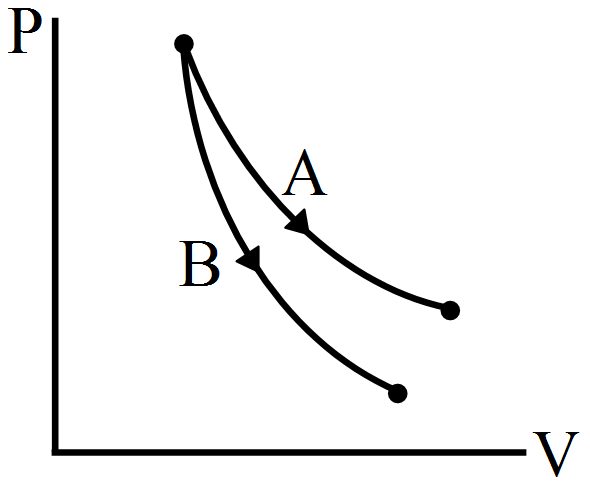
Consider the processes A and B shown in the figure. It is possible that:
  • A
    Both the processes are isothermal.
  • B
    Both the processes are adiabatic.
  • A is isothermal and B is adiabatic.
  • D
    A is adiabatic and B is isothermal.

Answer

Correct option: C.
A is isothermal and B is adiabatic.
The slope of an adiabatic process is greater than that of an isothermal process. Since A and B are initiated from the same initial state, both cannot be isothermal or adiabatic, as they would be overlapping. But the curve of process B is steeper than the curve of process A. Hence, A is isothermal and B is adiabatic.

Need a full question paper?

Generate a complete, print-ready paper with questions like this in minutes — across 16+ boards, with answer keys.

Start Generating Free

Similar questions

Power factor of an ideal choke coil (i.e., $R=0$ ) is
Holes are charge carriers in
When $\sqrt {3}$ ampere current is passed in a tangent galvanometer, there is a deflection of 30° in it. The deflection obtained when 3 amperes current is passed, is
Three capacitors of capacitances 3 μF, 9μF and 18 μF are connected once in series and another time in parallel. The ratio of equivalent capacitance in the two cases $\left(\frac{\mathrm{C}_8}{\mathrm{C}_{\mathrm{p}}}\right)$ will be
In the hysteresis cycle, the value of H needed to make the intensity of magnetisation zero is called
The magnetic field of a plane electromagnetic wave is given by $\overrightarrow{ B }=3 \times 10^{-8} \cos \left(1.6 \times 10^3 x +48 \times 10^{10} t \right) \hat{ j }$, then the associated electric field will be :
A parallel beam of light emerges from the opposite surface of the sphere when a point source of light lies at the surface of the sphere. The refractive index of the sphere is
An electric dipole of moment $\overrightarrow p $ is placed normal to the lines of force of electric intensity $\overrightarrow E $, then the work done in deflecting it through an angle of $180^\circ $ is
Consider an electron in the $n^{\text {th }}$ orbit of a hydrogen atom in the Bohr model. The circumference of the orbit can be expressed in terms of the de Broglie wavelength λ of that electron as
In a YDSE bi-chromatic light of wavelengths 400 nm and 560 nm are used. The distance between the slits is 0.1 mm and the distance between the plane of the slits and the screen is 1m. The minimum distance between two successive regions of complete darkness is