MCQ
Consider the quantities, pressure, power, energy, impulse, gravitational potential, electrical charge, temperature, area. Out of these, the only vector quantities are
  • A
    Impulse, pressure and area.
  • Impulse and area.
  • C
    Area and gravitational potential.
  • D
    Impulse and pressure.

Answer

Correct option: B.
Impulse and area.
We know that impulse $J = F. \Delta\text{t}=\Delta\text{p},$
where $F$ is force, At is time duration and $Ap$ is change in momentum.
As $\Delta\text{p}$ is a vector quantity,
hence impulse is also a vector quantity.
Sometimes area can also be treated as vector direction of area vector is perpendicular to its plane.

Need a full question paper?

Generate a complete, print-ready paper with questions like this in minutes — across 16+ boards, with answer keys.

Start Generating Free

Similar questions

A wall has two layers $A$ and $B$, each made of a different material. Both the layers have the same thickness. The thermal conductivity of the material of $A$ is twice that of $B$. Under thermal equilibrium, the temperature difference across the wall is $36\,^oC$. The temperature difference across the layer $A$ is ......... $^oC$
A gas is enclosed in a closed pot. On keeping this pot in a train moving with high speed, the temperature of the gas
One mole of an ideal monatomic gas requires $210 \,J$ heat to raise the temperature by $10\, K$, when heated at constant temperature. If the same gas is heated at constant volume to raise the temperature by $10\, K$ then heat required is  ....... $J$
Liquid oxygen at $50\  K$ is heated to $300\  K$ at constant pressure of $1\  atm$. The rate of heating is constant which of the following graphs represents the variation of temperature with time
A cube of aluminium of sides $0.1\, m$ is subjected to a shearing force of $100\, N$. The top face of the cube is displaced through $0.02 \,cm$ with respect to the bottom face. The shearing strain would be
Ice at $-20\,^oC$ is added to $50\,g$ of water at $40\,^oC.$ When the temperature of the mixture reaches $0\,^oC,$ it is found that $20\,g$ of ice is still unmelted. The amount of ice added to the water was close to ........$g$ (Specific heat of water $= 4.2\,J/g/^oC)$ Heat of fusion of water at $0^oC = 334\,J/g$ )
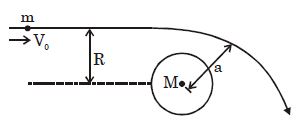
A mass $m$ , travelling at speed $V_0$ in a straight line from far away is deflected when it passes near a black hole of mass $M$ which is at a perpendicular distance $R$ from the original line of flight. $a$ , the distance of closest approach between the mass and the black hole is given by the relation 
The ratio of mean kinetic energy of hydrogen and oxygen at a given temperature is
Trajectory of particle in a projectile motion is given as $y=x-\frac{x^2}{80}$. Here, $x$ and $y$ are in metre. For this projectile motion match the following with $g=10\,m / s ^2$.
$Column-I$ $Column-II$
$(A)$ Angle of projection $(p)$ $20\,m$
$(B)$ Angle of velocity with horizontal after $4\,s$ $(q)$ $80\,m$
$(C)$ Maximum height $(r)$ $45^{\circ}$
$(D)$ Horizontal range $(s)$ $\tan ^{-1}\left(\frac{1}{2}\right)$
The kerosene oil rises up in the wick of a lamp ...........