Question
Consider the situation described in the previous problem. Show that the force on the sphere due to the light falling on it is the same even if the sphere is not perfectly absorbing.

Answer

For a perfectly reflecting solid sphere of radius ‘r’ kept in the path of a parallel beam of light of large aperture with intensity ‘I’, force exerted $=\frac{\pi\text{r}^2\text{I}}{\text{C}}$

Need a full question paper?

Generate a complete, print-ready paper with questions like this in minutes — across 16+ boards, with answer keys.
Start Generating Free

Similar questions

Can a hydrogen atom emit characteristic X-rays?
At which point on its path a projectile has the smallest speed?
A converging lens of focal length $12\ cm$ and a diverging mirror of focal length $7.5\ cm$ are placed $5.0\ cm$ apart with their principal axes coinciding. Where should an object be placed so that its image falls on itself?
What is the electrostatic potential due to an electric dipole at an equatorial point?
The magnifying power of a simple microscope will be maximum for which colour of light and minimum for which colour of light?
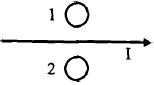
Predict the directions of induced currents in metal rings 1 and 2 lying in the same plane where current I in the wire is increasing steadily.
In an n-type silicon, which of the following statement is true:
  1. Electrons are majority carriers and trivalent atoms are the dopants.
  2. Electrons are minority carriers and pentavalent atoms are the dopants.
  3. Holes are minority carriers and pentavalent atoms are the dopants.
  4. Holes are majority carriers and trivalent atoms are the dopants.
A 500 µC charge is at the centre of a square of side 10 cm. Find the work done in moving a charge of 10 µC between two diagonally opposite points on the square.
Answer carefully:
What is the work done by the field of a nucleus in a complete circular orbit of the electron? What if the orbit is elliptical?
A metallic metre stick moves with a velocity of $2m/s^{-1}$ in a direction perpendicular to its length and perpendicular to a uniform magnetic field of magnitude $0.2 T.$ Find the emf induced between the ends of the stick.