Question
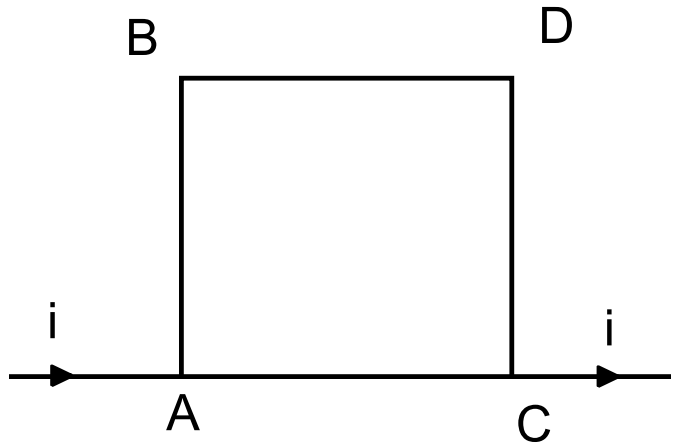
Consider the situation described in the previous problem. Suppose the current i enters the loop at the point A and leaves it at the point B. Find the magnetic field at the centre of the loop.
Answer


$\overrightarrow{\text{B}}$ due t BC

$\overrightarrow{\text{B}}$ due to AD at Pt ‘P’ are equal ore Opposite

Hence net $\overrightarrow{\text{B}}=0$

Similarly, due to AB & CD at P = 0 

$\therefore$ The net B  at the Centre of the square loop = zero

Need a full question paper?

Generate a complete, print-ready paper with questions like this in minutes — across 16+ boards, with answer keys.
Start Generating Free

Similar questions

What are circular and elliptically polarized light?
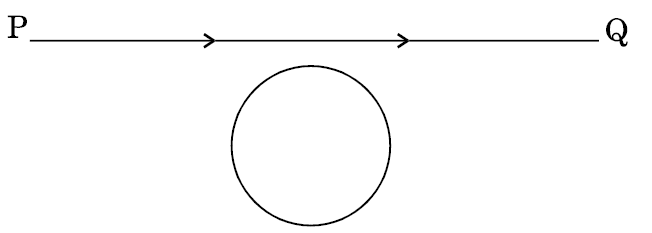
A conducting loop is held below a current carrying wire PQ as shown. Predict the direction of the induced current in the loop when the current in the wire is constantly increasing.

Two coils one of larger radius $R$ and other of smaller radius $r$ are kept near. If mutual induction coefficient for this pair is 1 mH what is the magnetic flux associated with the larger coil when a current of 0.5 A is flowing in the smaller coil? When current in smaller coil is zero then what is its effect on larger coil?
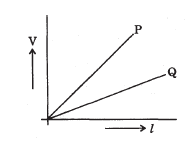
The variation of potential difference V with lengthlin case of two potentiometers P and Q is as shown. Which one of these two will you prefer for comparing emfs of two primary cells?

Which part of electromagnetic spectrum is used in satellite communication?
Write mathematical expression for Ampere- Maxwell's law.
The magnitude of linear momentum of a particle moving at a relativistic speed v is proportional to:
  1. $\text{v}$
  2. $\sqrt{1-\frac{\text{v}^2}{\text{c}^2}}$
  3. $1-\frac{\text{v}^2}{\text{c}^2}$
  4. None of these.
A circular loop of radius 4.0cm is placed in a horizontal plane and carries an electric current of 5.0A in the clockwise direction as seen from above. Find the magnetic field:
  1. At a point 3.0cm above the centre of the loop.
  2. At a point 3.0cm below the centre of the loop.
State any two factors responsible for energy loss in practical transformer.
Answer the following questions:
The charged currents in the outer conducting regions of the earth’s core are thought to be responsible for earth’s magnetism. What might be the ‘battery’ (i.e., the source of energy) to sustain these currents?