Question
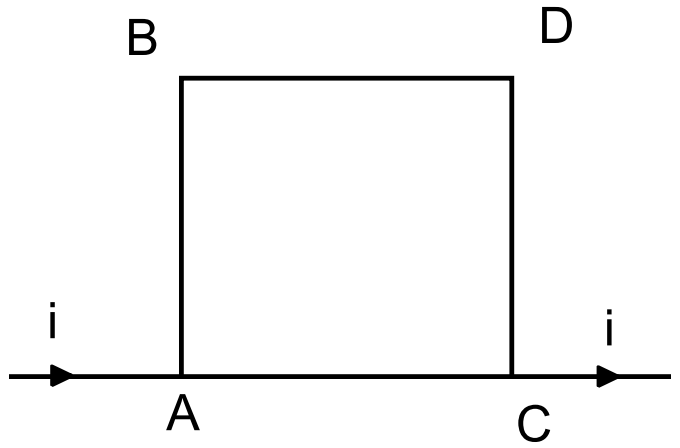
Consider the situation described in the previous problem. Suppose the current i enters the loop at the point A and leaves it at the point B. Find the magnetic field at the centre of the loop.
Answer


$\overrightarrow{\text{B}}$ due t BC
$\overrightarrow{\text{B}}$ due to AD at Pt ‘P’ are equal ore Opposite
Hence net $\overrightarrow{\text{B}}=0$
Similarly, due to AB & CD at P = 0 
$\therefore$ The net B  at the Centre of the square loop = zero

Need a full question paper?

Generate a complete, print-ready paper with questions like this in minutes — across 16+ boards, with answer keys.

Start Generating Free

Similar questions

Define 1 henry.
An arbitrary surface encloses a dipole. What is the electric flux through this surface?
Does a gas have just two specific heat capacities or more than two? Is the number of specific heat capacities of a gas countable?
Which of the statements is true for p-type semiconductos.
  1. Electrons are majority carriers and trivalent atoms are the dopants.
  2. Electrons are minority carriers and pentavalent atoms are the dopants.
  3. Holes are minority carriers and pentavalent atoms are the dopants.
  4. Holes are majority carriers and trivalent atoms are the dopants.
Mark the correct statements:
  1. Equations of special relativity are not applicable for small speeds.
  2. Equations of special relativity are applicable for all speeds.
  3. Nonrelativistic equations give exact result for small speeds.
  4. Nonrelativistic equations never give exact result.
Is the ratio of frequencies of ultraviolet rays and infrared rays in glass more than, less than or equal to 1?
A ball is dropped on a floor from a height of 2.0m. After the collision it rises up to a height of 1.5m. Assume that 40% of the mechanical energy lost goes as thermal energy into the ball. Calculate the rise in the temperature of the ball in the collision. Heat capacity of the ball is $800JK^{-1}$.
In a TV tube, electrons are accelerated from the rear to the front. What is the direction of the current?
Where on the surface of Earth is the angle of dip $90^{\circ}$?
Write the relation between object distance ( $u$ ), image distance $(v)$ and focal length $(f)$ for a concave mirror.