Question
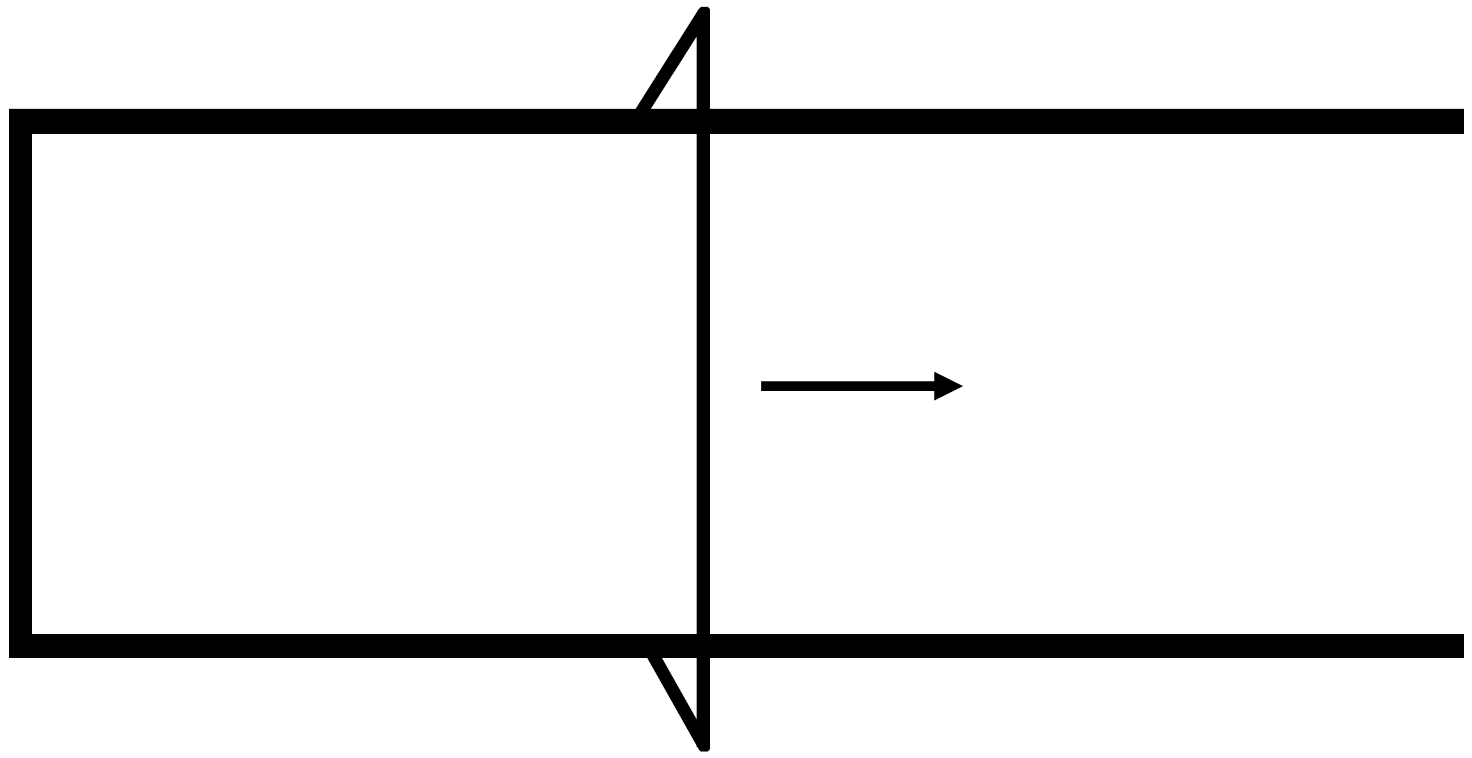
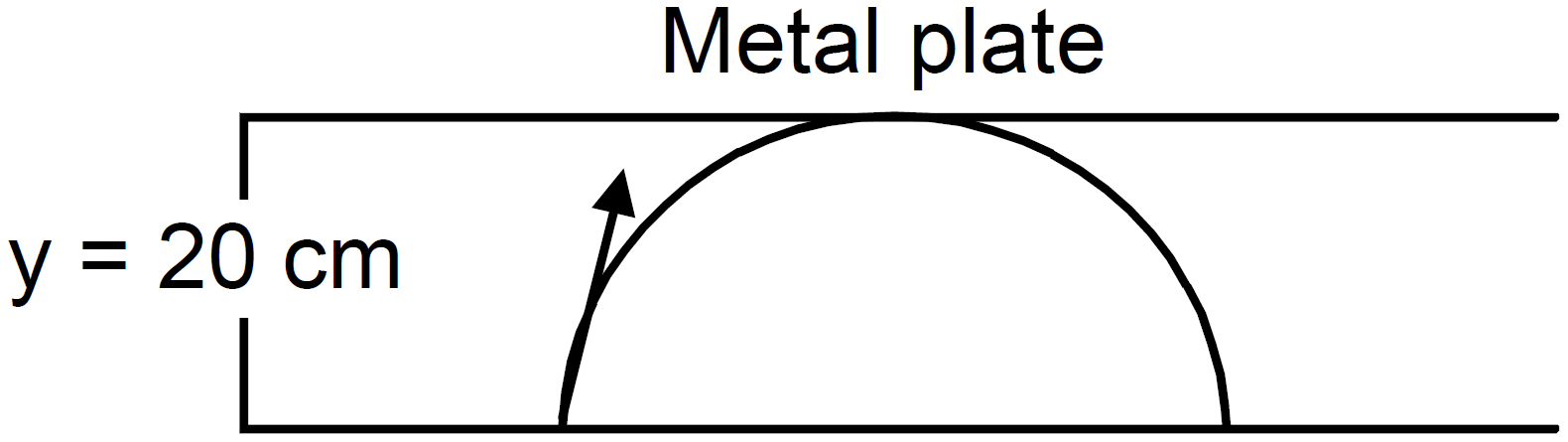
Consider the situation of the previous problem. Consider the fastest electron emitted parallel to the large metal plate. Find the displacement of this electron parallel to its initial velocity before it strikes the large metal plate.
Answer

Here electric field of metal plate $=\text{E}=\frac{\text{p}}{\text{E}_0}$
$=\frac{1\times10^{-19}}{8.85\times10^{-12}}=113\text{v/m}$
accl. de $=\phi=\frac{\text{qE}}{\text{m}}$
$=\frac{1.6\times10^{-19}\times113}{9.1\times10^{-31}}=19.87\times10^{12}$
$\text{t}=\frac{\sqrt{2\text{y}}}{\text{a}}=\frac{\sqrt{2\times20\times10^{-2}}}{19.87\times10^{-31}}=1.41\times10^{-7}\text{sec}$
$K.E. =\frac{\text{hc}}{\lambda}-\text{w}=1.2\text{ev} = 1.2 \times 1.6 \times 10 - 19J [$because in previous problem i.e. in problem $31 : KE = 1.2ev]$
$\therefore\text{v}=\frac{\sqrt{2\text{KE}}}{\text{m}}$
$=\frac{\sqrt{2\times1.2\times1.6\times10^{-19}}}{4.1\times10^{-31}}=0.665\times10^{-6}$
$\therefore$ Horizontal displacement $= Vt \times t$
$= 0.655 \times 10^{-6} \times 1.4 \times 10^{-7} = 0.092m = 9.2\ cm.$

Need a full question paper?

Generate a complete, print-ready paper with questions like this in minutes — across 16+ boards, with answer keys.
Start Generating Free

Similar questions

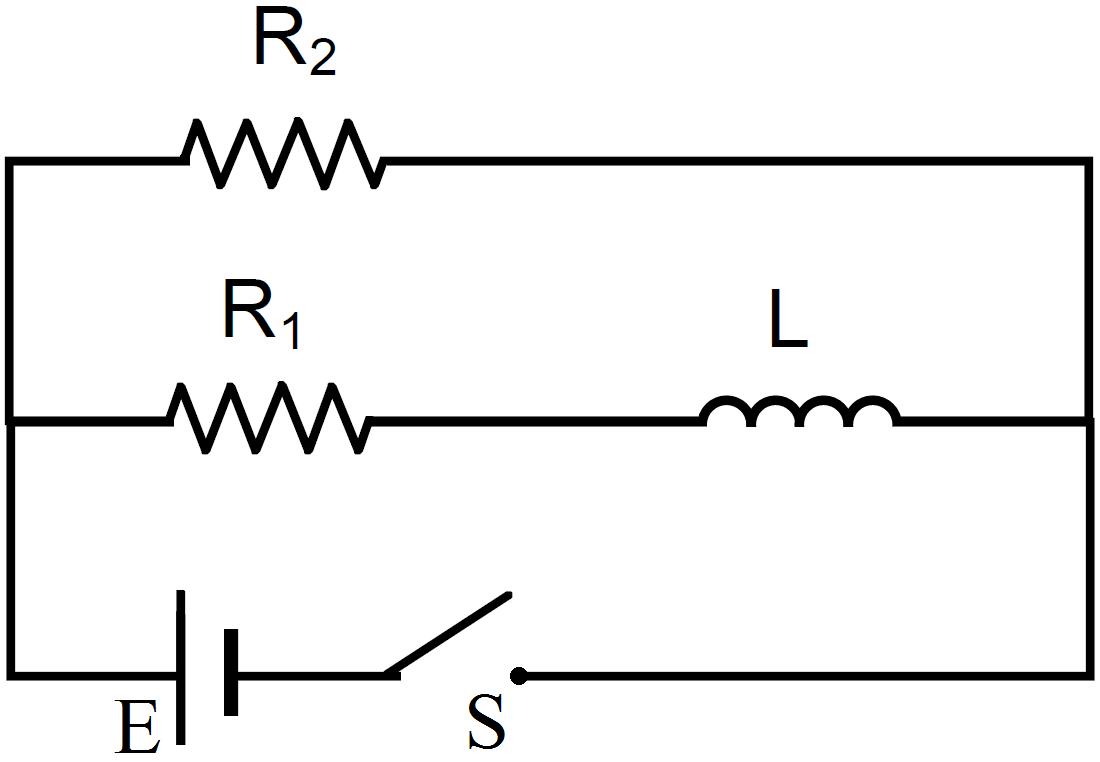
Consider the circuit shown in figure:
  1. Find the current through the battery a long time after the switch S is closed.
  2. Suppose the switch is again opened at $t = 0$. What is the time constant of the discharging circuit?
  3. Find the current through the inductor after one time constant.
  1. Draw a ray diagram to show image formation when the concave mirror produces a real, inverted and magnified image of the object.
  2. Obtain the mirror formula and write the expression for the linear magnification.
  3. Explain two advantages of a reflecting telescope over a refracting telescope.
The two blocks in an Atwood machine have masses $2.0\ kg$ and $3.0\ kg$. Find the work done by gravity during the fourth second after the system is released from rest.
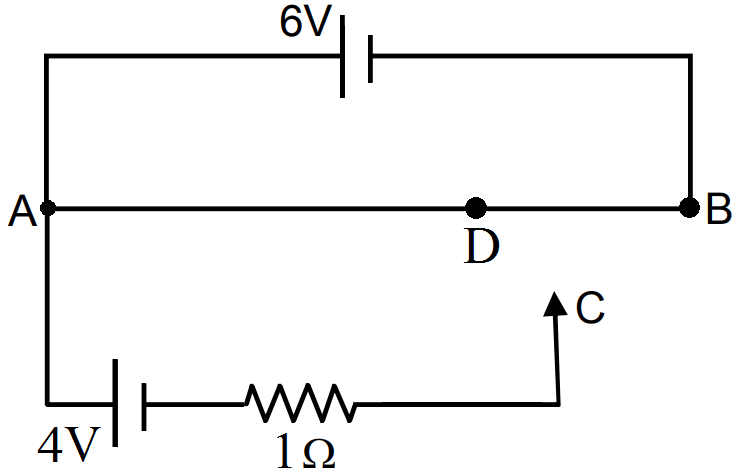
A $6$ volt battery of negligible internal resistance is connected across a uniform wire $AB$ of length $100\ cm.$ The positive terminal of another battery of emf $4V$ and internal resistance $1\Omega$ is joined to the point $A,$ as shown in the figure. Take the potential at $B$ to be zero.$ (a)$ What are the potentials at the points $A$ and $C$ ? $(b) $ At which point $D$ of the wire $AB,$ the potential is equal to the potential at $C$ ? $ (c)$ If the points $C$ and $D$ are connected by a wire, what will be the current through it? $(d)$ If the $4V$ battery is replaced by a $7.5V $ battery, what would be the answers of parts $(a)$ and $(b)$?
A spherical ball of mass m and radius r rolls without slipping on a rough concave surface of large radius R. It makes small oscillations about the lowest point, Find the time period.
A series $\text{LCR}$ circuit with $\text{L = 0.12H, C = 480nF, R} = 23\Omega$ is connected to a $230V$ variable frequency supply.
  1. What is the source frequency for which current amplitude is maximum. Obtain this maximum value.
  2. What is the source frequency for which average power absorbed by the circuit is maximum. Obtain the value of this maximum power.
  3. For which frequencies of the source is the power transferred to the circuit half the power at resonant frequency? What is the current amplitude at these frequencies?
  4. What is the $Q-$ factor of the given circuit?
A coil of radius 10cm and resistance $40\Omega$ has 1000 turns. It is placed with its plane vertical and its axis parallel to the magnetic meridian. The coil is connected to a galvanometer and is rotated about the vertical dimeter through an angle of 180°. Find the charge which flows through the galvanometer if the horizontal component of the earth's magnetic field is $\text{B}_{\text{H}}=3.0\times10^{-5}\text{T}.$
Figure shows a metallic wire of resistance $0.20\Omega$ sliding on a horizontal, $U-$shaped metallic rail. The separation between the parallel arms is $20\ cm$. An electric current of $2.0\mu\text{A}$ passes through the wire when it is slid at a rate of $20\ cms^{-1}.$ If the horizontal component of the earth's magnetic field is $3.0 \times 10^{-5} T$, calculate the dip at the place.
An eye can distinguish between two points of an object if they are separated by more than $0.22\ mm$ when the object is placed at $25\ cm$ from the eye. The object is now seen by a compound microscope having a $20D$ objective and $10D$ eyepiece separated by a distance of $20\ cm$. The final image is formed at $25\ cm$ from the eye. What is the minimum separation between two points of the object which can now be distinguished?
Derive an expression for magnetic field intensity due to a magnetic dipole at a point on its axial line.