Question
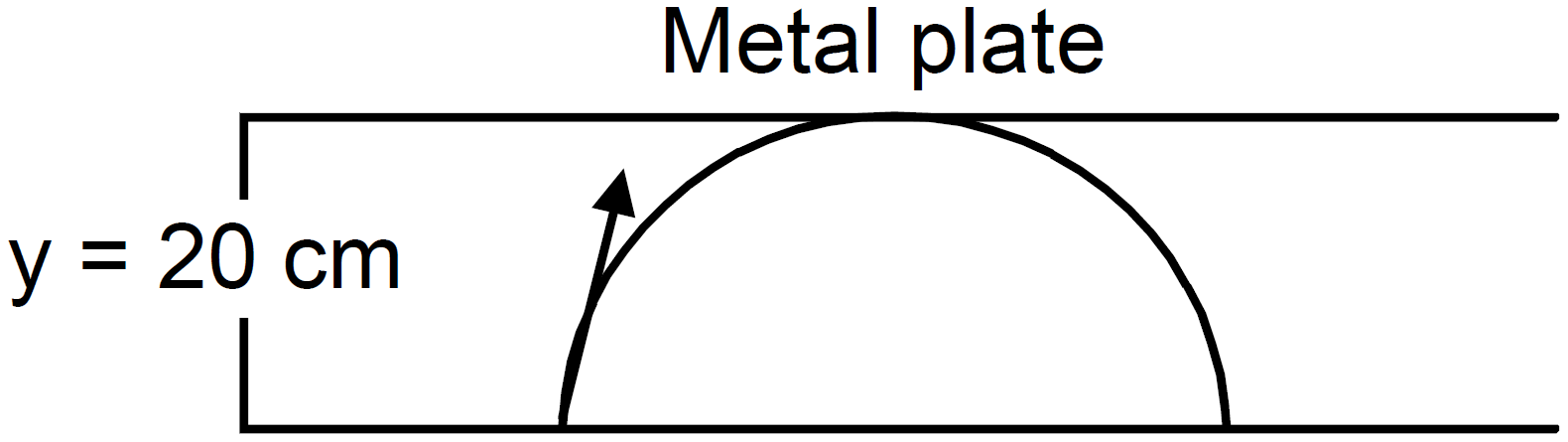
Consider the situation of the previous problem. Consider the fastest electron emitted parallel to the large metal plate. Find the displacement of this electron parallel to its initial velocity before it strikes the large metal plate.
Answer

Here electric field of metal plate $=\text{E}=\frac{\text{p}}{\text{E}_0}$$=\frac{1\times10^{-19}}{8.85\times10^{-12}}=113\text{v/m}$
accl. de $=\phi=\frac{\text{qE}}{\text{m}}$$=\frac{1.6\times10^{-19}\times113}{9.1\times10^{-31}}=19.87\times10^{12}$
$\text{t}=\frac{\sqrt{2\text{y}}}{\text{a}}=\frac{\sqrt{2\times20\times10^{-2}}}{19.87\times10^{-31}}=1.41\times10^{-7}\text{sec}$
K.E. $=\frac{\text{hc}}{\lambda}-\text{w}=1.2\text{ev}$ = 1.2 × 1.6 × 10 - 19J [because in previous problem i.e. in problem 31 : KE = 1.2ev]$\therefore\text{v}=\frac{\sqrt{2\text{KE}}}{\text{m}}$
$=\frac{\sqrt{2\times1.2\times1.6\times10^{-19}}}{4.1\times10^{-31}}=0.665\times10^{-6}$
$\therefore$ Horizontal displacement $= Vt × t$
$= 0.655 \times 10^{-6} \times 1.4 \times 10^{-7} = 0.092m = 9.2cm.$

Need a full question paper?

Generate a complete, print-ready paper with questions like this in minutes — across 16+ boards, with answer keys.
Start Generating Free

Similar questions

Hari is a student of Class X in a school near his village. His uncle gifted him a bicycle with a dynamo fitted in it. He was thrilled to find that while cycling during night, he could light the bulb and see the objects on the road clearly. He, however, did not know how this device works. He asked this question to his teacher. The teacher considered it an opportunity and explained the working of a dynamo to the whole class.
Answer the following questions:
  1. State the principle and working of a dynamo.
  2. Write two values each displayed by Hari and his Science teacher.
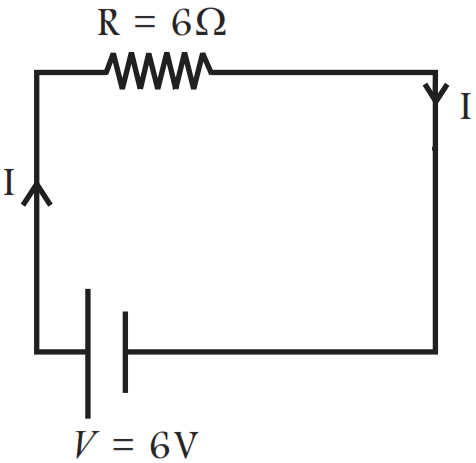
Consider circuit in Fig. How much energy is absorbed by electrons from the initial state of no current (ignore thermal motion) to the state of drift velocity?
A turn of radius 20m is banked for the vehicles going at a speed of 36 km/h. If the coefficient of static friction between the road and the tyre is 0.4, what are the possible speeds of a vehicle so that it neither slips down nor skids up?
Explain the variation of conductivity with temperature for:
  1. A metallic conductor.
  2. Ionic conductors.
  3. Semiconductors.
We have stimulated emission and spontaneous emission. Do we also have stimulated absorption and spontaneous absorption?
A capacitor of capacitance C is given a charge Q. At t = 0, it is connected to an uncharged capacitor of equal capacitance through a resistance R. Find the charge on the second capacitor as a function of time.
Two small spheres, each having a mass of 20g, are suspended from a common point by two insulating strings of length 40cm each. The spheres are identically charged and the separation between the balls at equilibrium is found to be 4cm. Find the charge on each sphere.
The intensity of the sunlight reaching Earth is $1380Wm^{-2}$. Assume this light to be a plane, monochromatic wave. Find the amplitudes of electric and magnetic fields in this wave.
Is it possible that in a Coolidge tube characteristic $\text{L}_\alpha$ X-rays are emitted but not $\text{K}_\alpha$ X-rays?
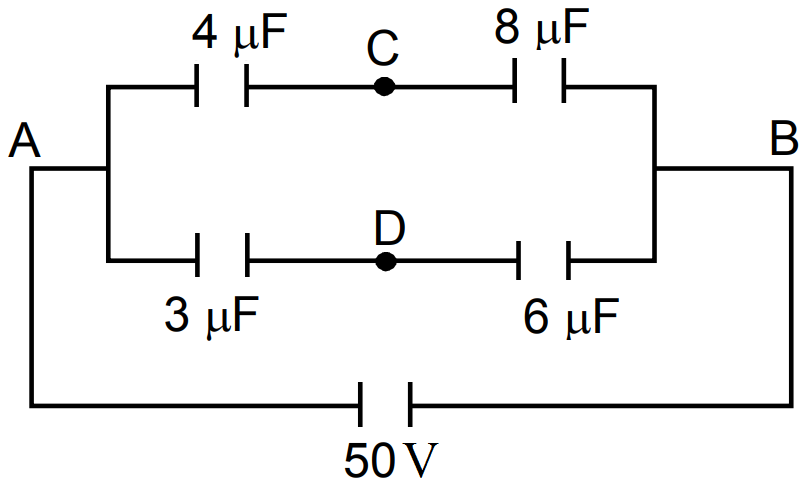
Take the potential of the point B in figure to be zero:
  1. Find the potentials at the points C and D.
  2. If a capacitor is connected between C and D, what charge will appear on this capacitor?